if f(x) = ∫₁ˣ² sin(2t) dt, then f(x) = 2x sin(2x²) sin(2x²) -2x cos(2x²) - cos(2x²)
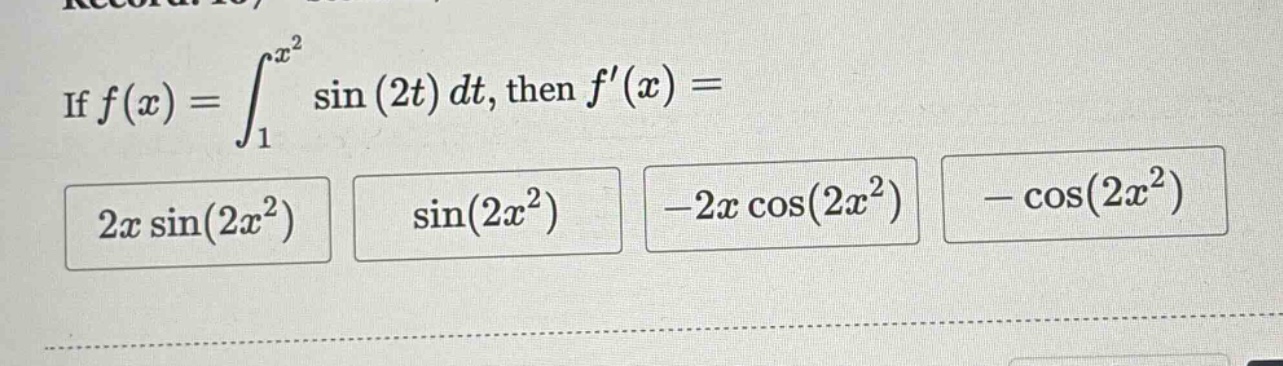
if f(x) = ∫₁ˣ² sin(2t) dt, then f(x) = 2x sin(2x²) sin(2x²) -2x cos(2x²) - cos(2x²)
Answer
Answer:
$2x\sin(2x^{2})$
Explanation:
Step1: Apply the fundamental theorem of calculus and chain - rule
Let $u = x^{2}$, then $f(x)=\int_{1}^{u}\sin(2t)dt$. By the fundamental theorem of calculus, if $F(t)$ is an antiderivative of $\sin(2t)$ (i.e., $F^\prime(t)=\sin(2t)$), then $\int_{1}^{u}\sin(2t)dt=F(u)-F(1)$.
Step2: Differentiate with respect to $x$
Using the chain - rule, $\frac{d}{dx}f(x)=\frac{d}{du}(F(u)-F(1))\cdot\frac{du}{dx}$. Since $\frac{d}{du}(F(u)-F(1)) = F^\prime(u)=\sin(2u)$ and $\frac{du}{dx}=2x$.
Step3: Substitute $u = x^{2}$ back
Substitute $u = x^{2}$ into the expression. We get $\frac{d}{dx}f(x)=\sin(2x^{2})\cdot2x = 2x\sin(2x^{2})$.