1. if y = x² sin 2x, then dy/dx = (a) 2x cos 2x (b) 4x cos 2x (c) 2x(sin 2x + cos 2x) (d) 2x(sin 2x - x cos…
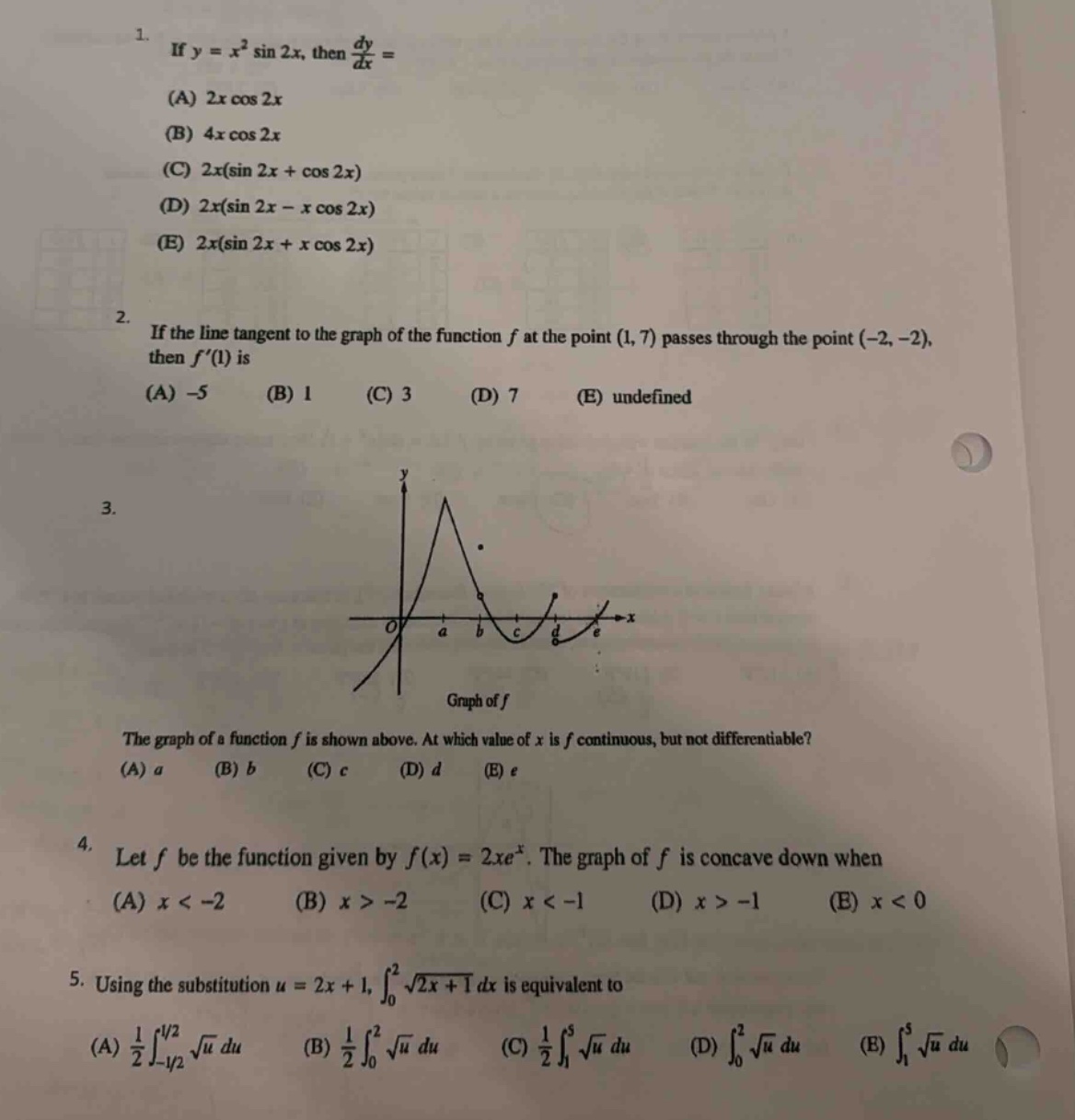
1. if y = x² sin 2x, then dy/dx = (a) 2x cos 2x (b) 4x cos 2x (c) 2x(sin 2x + cos 2x) (d) 2x(sin 2x - x cos 2x) (e) 2x(sin 2x + x cos 2x) 2. if the line tangent to the graph of the function f at the point (1, 7) passes through the point (-2, -2), then f(1) is (a) -5 (b) 1 (c) 3 (d) 7 (e) undefined 3. the graph of a function f is shown above. at which value of x is f continuous, but not differentiable? (a) a (b) b (c) c (d) d (e) e 4. let f be the function given by f(x) = 2xe^x. the graph of f is concave down when (a) x < -2 (b) x > -2 (c) x < -1 (d) x > -1 (e) x < 0 5. using the substitution u = 2x + 1, ∫₀² √(2x + 1) dx is equivalent to (a) 1/2 ∫₋₁/₂¹/₂ √u du (b) 1/2 ∫₀² √u du (c) 1/2 ∫₁⁵ √u du (d) ∫₀² √u du (e) ∫₁⁵ √u du
Answer
Explanation:
Step1: Apply product - rule for question 1
The product - rule states that if $y = u\cdot v$, where $u = x^{2}$ and $v=\sin2x$, then $\frac{dy}{dx}=u'\cdot v + u\cdot v'$. We know that $u' = 2x$ and $v'=2\cos2x$. So $\frac{dy}{dx}=2x\sin2x + 2x^{2}\cos2x=2x(\sin2x + x\cos2x)$.
Step2: Find the slope for question 2
The derivative $f^{\prime}(1)$ is the slope of the tangent line to the graph of $y = f(x)$ at $x = 1$. The slope $m$ of the line passing through two points $(x_1,y_1)=(1,7)$ and $(x_2,y_2)=(-2,-2)$ is given by $m=\frac{y_2 - y_1}{x_2 - x_1}=\frac{-2 - 7}{-2 - 1}=\frac{-9}{-3}=3$.
Step3: Identify non - differentiable point for question 3
A function is continuous but not differentiable at a point where there is a sharp corner. At point $b$, the function $y = f(x)$ is continuous (no break in the graph) but has a sharp turn, so it is not differentiable there.
Step4: Find second - derivative for question 4
First, find the first - derivative of $f(x)=2xe^{x}$ using the product - rule. Let $u = 2x$ and $v = e^{x}$, then $f^{\prime}(x)=2e^{x}+2xe^{x}=2e^{x}(1 + x)$. Then find the second - derivative $f^{\prime\prime}(x)=2e^{x}+2e^{x}(1 + x)=2e^{x}(2 + x)$. The function is concave down when $f^{\prime\prime}(x)<0$. Since $e^{x}>0$ for all $x$, we solve $2 + x<0$, which gives $x<-2$.
Step5: Use substitution for question 5
If $u = 2x + 1$, then $du=2dx$ or $dx=\frac{1}{2}du$. When $x = 0$, $u = 1$; when $x = 2$, $u=2\times2 + 1=5$. So $\int_{0}^{2}\sqrt{2x + 1}dx=\frac{1}{2}\int_{1}^{5}\sqrt{u}du$.
Answer:
- E. $2x(\sin2x + x\cos2x)$
- C. $3$
- B. $b$
- A. $x < - 2$
- C. $\frac{1}{2}\int_{1}^{5}\sqrt{u}du$