if f(x) = ∫_{-4}^{x} (sin(t²) - 3) dt, then f(x) = -1/2x cos(x²) - 3x sin(x²) sin(x²) - 3 2x sin(x²) - 3
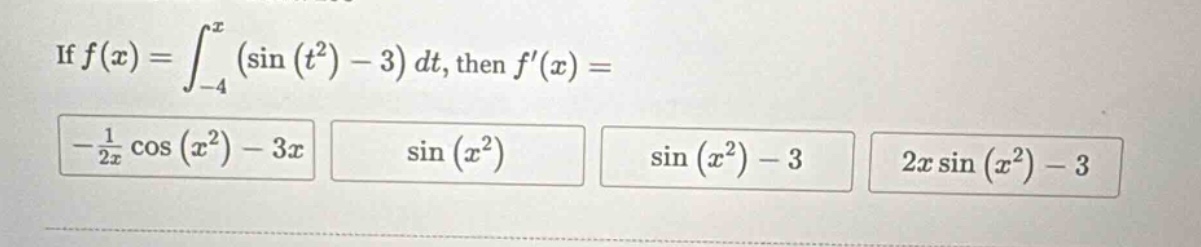
if f(x) = ∫_{-4}^{x} (sin(t²) - 3) dt, then f(x) = -1/2x cos(x²) - 3x sin(x²) sin(x²) - 3 2x sin(x²) - 3
Answer
Answer:
C. $\sin(x^{2}) - 3$
Explanation:
Step1: Recall the fundamental theorem of calculus
If $F(x)=\int_{a}^{x}g(t)dt$, then $F^\prime(x) = g(x)$.
Step2: Identify the function $g(t)$
Here, $g(t)=\sin(t^{2}) - 3$.
Step3: Apply the theorem
Since $f(x)=\int_{-4}^{x}(\sin(t^{2}) - 3)dt$, by the fundamental theorem of calculus, $f^\prime(x)=\sin(x^{2}) - 3$.