y = - 3 sin(-x + π/3)-2\nthe phase - shift of y = - 3 sin(-x + π/3)-2 is \n(simplify your answer. type an…
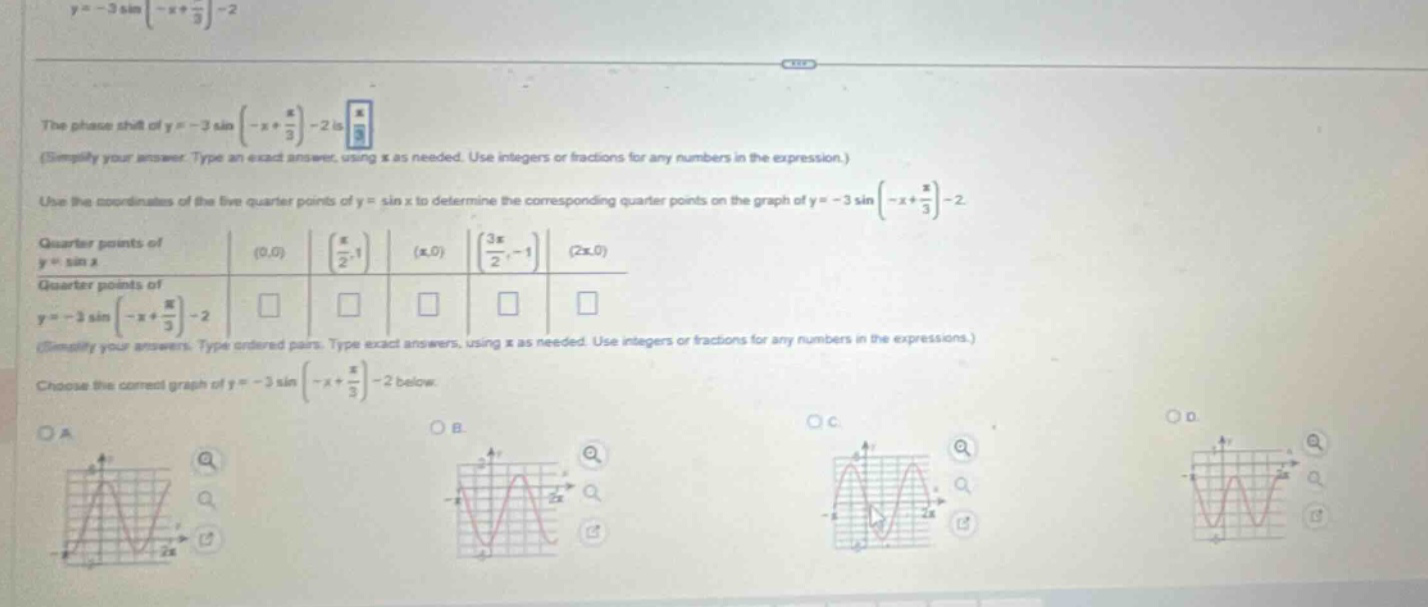
y = - 3 sin(-x + π/3)-2\nthe phase - shift of y = - 3 sin(-x + π/3)-2 is \n(simplify your answer. type an exact answer, using π as needed. use integers or fractions for any numbers in the expression.)\nuse the coordinates of the five - quarter points of y = sin x to determine the corresponding quarter points on the graph of y = - 3 sin(-x + π/3)-2.\nquarter points of y = sin x: (0,0) (π/2,1) (π,0) (3π/2,-1) (2π,0)\nquarter points of y = - 3 sin(-x + π/3)-2 \n(simplify your answers. type ordered pairs. type exact answers, using π as needed. use integers or fractions for any numbers in the expressions.)\nchoose the correct graph of y = - 3 sin(-x + π/3)-2 below.\noa\nob\noc\nod
Answer
Explanation:
Step1: Recall phase - shift formula
For the sine function $y = A\sin(Bx - C)+D$, the phase - shift is given by $\frac{C}{B}$. First, rewrite the given function $y=-3\sin(-x + \frac{\pi}{3})-2$ in the form $y = A\sin(Bx - C)+D$. Here, $y=-3\sin(-(x-\frac{\pi}{3}))-2$, so $A=-3$, $B=- 1$, and $C=\frac{\pi}{3}$.
Step2: Calculate the phase - shift
Using the phase - shift formula $\text{Phase - shift}=\frac{C}{B}$, substitute $C = \frac{\pi}{3}$ and $B=-1$. Then $\text{Phase - shift}=\frac{\frac{\pi}{3}}{-1}=-\frac{\pi}{3}$.
Step3: Find the quarter - points transformation
For the function $y = \sin x$, the quarter - points are $(0,0),(\frac{\pi}{2},1),(\pi,0),(\frac{3\pi}{2},-1),(2\pi,0)$. For the function $y=-3\sin(-x+\frac{\pi}{3})-2$, we use the transformation $x'=x-\frac{\pi}{3}$ (from $-x+\frac{\pi}{3}=- (x - \frac{\pi}{3})$) and $y'=-3y - 2$.
- For $(0,0)$:
- First, find the new $x$ value: Let $-x+\frac{\pi}{3}=0$, then $x=\frac{\pi}{3}$.
- Then find the new $y$ value: $y=-3\times0 - 2=-2$. So the point is $(\frac{\pi}{3},-2)$.
- For $(\frac{\pi}{2},1)$:
- Let $-x+\frac{\pi}{3}=\frac{\pi}{2}$, then $x=-\frac{\pi}{6}$.
- $y=-3\times1 - 2=-5$. So the point is $(-\frac{\pi}{6},-5)$.
- For $(\pi,0)$:
- Let $-x+\frac{\pi}{3}=\pi$, then $x =-\frac{2\pi}{3}$.
- $y=-3\times0 - 2=-2$. So the point is $(-\frac{2\pi}{3},-2)$.
- For $(\frac{3\pi}{2},-1)$:
- Let $-x+\frac{\pi}{3}=\frac{3\pi}{2}$, then $x=-\frac{7\pi}{6}$.
- $y=-3\times(-1)-2 = 1$. So the point is $(-\frac{7\pi}{6},1)$.
- For $(2\pi,0)$:
- Let $-x+\frac{\pi}{3}=2\pi$, then $x=-\frac{5\pi}{3}$.
- $y=-3\times0 - 2=-2$. So the point is $(-\frac{5\pi}{3},-2)$.
Answer:
Phase - shift: $-\frac{\pi}{3}$ Quarter - points: $(\frac{\pi}{3},-2),(-\frac{\pi}{6},-5),(-\frac{2\pi}{3},-2),(-\frac{7\pi}{6},1),(-\frac{5\pi}{3},-2)$