if $sin x = e^{y},0 < x < pi$, what is $\frac{dy}{dx}$ in terms of $x$?\na $-\tan x$\nb $-cot x$\nc $cot…
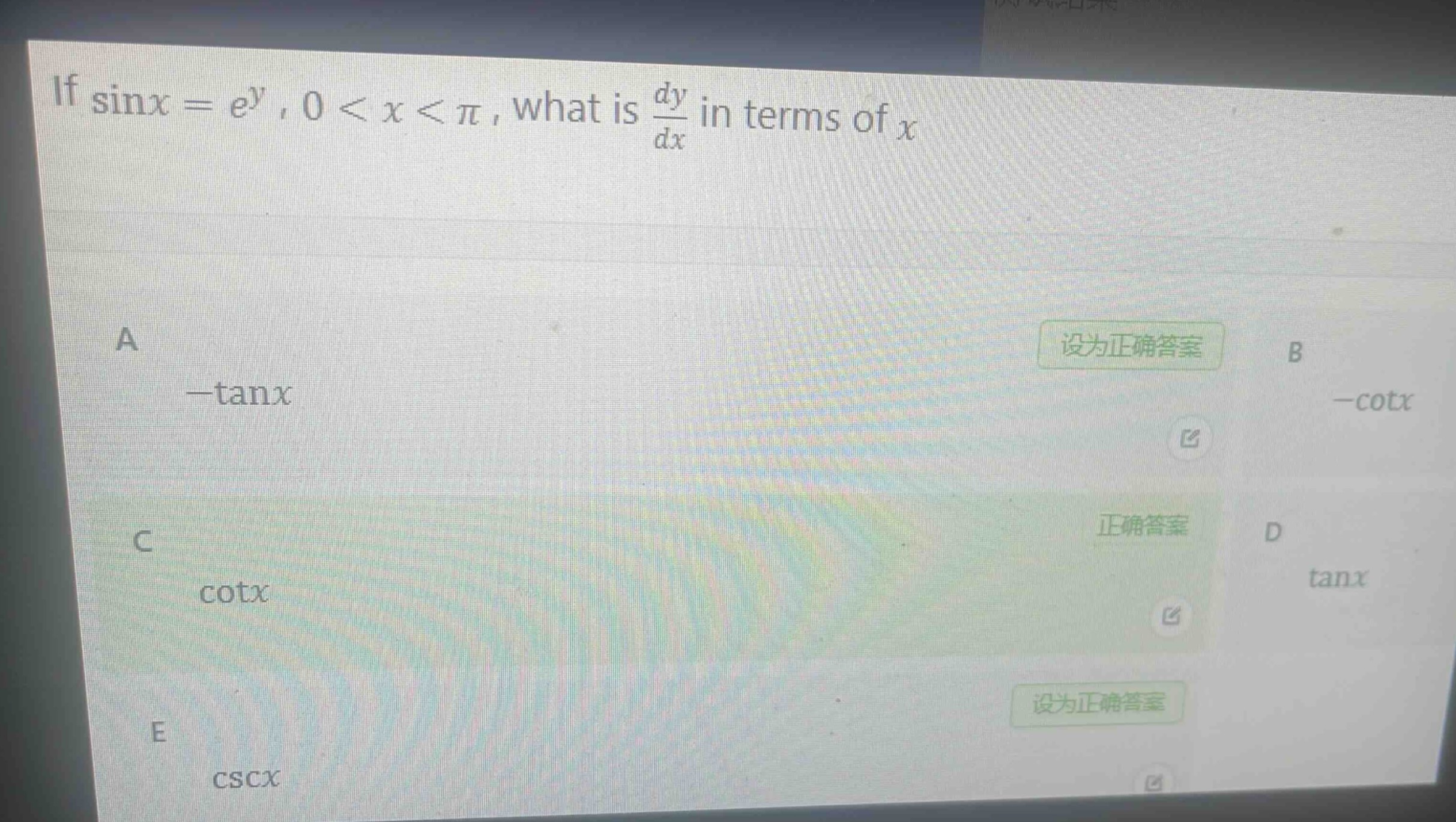
if $sin x = e^{y},0 < x < pi$, what is $\frac{dy}{dx}$ in terms of $x$?\na $-\tan x$\nb $-cot x$\nc $cot x$\nd $\tan x$\ne $csc x$
Answer
Explanation:
Step1: Differentiate both sides
Differentiate $\sin x = e^{y}$ with respect to $x$. The derivative of $\sin x$ with respect to $x$ is $\cos x$, and using the chain - rule, the derivative of $e^{y}$ with respect to $x$ is $e^{y}\frac{dy}{dx}$. So we have $\cos x=e^{y}\frac{dy}{dx}$.
Step2: Solve for $\frac{dy}{dx}$
Since $\sin x = e^{y}$, we can substitute $e^{y}$ with $\sin x$ in the equation $\cos x=e^{y}\frac{dy}{dx}$. Then $\frac{dy}{dx}=\frac{\cos x}{\sin x}$.
Step3: Simplify the expression
We know that $\frac{\cos x}{\sin x}=\cot x$.
Answer:
C. $\cot x$