y = -\\sin(x - \\pi)-2\ngraph.
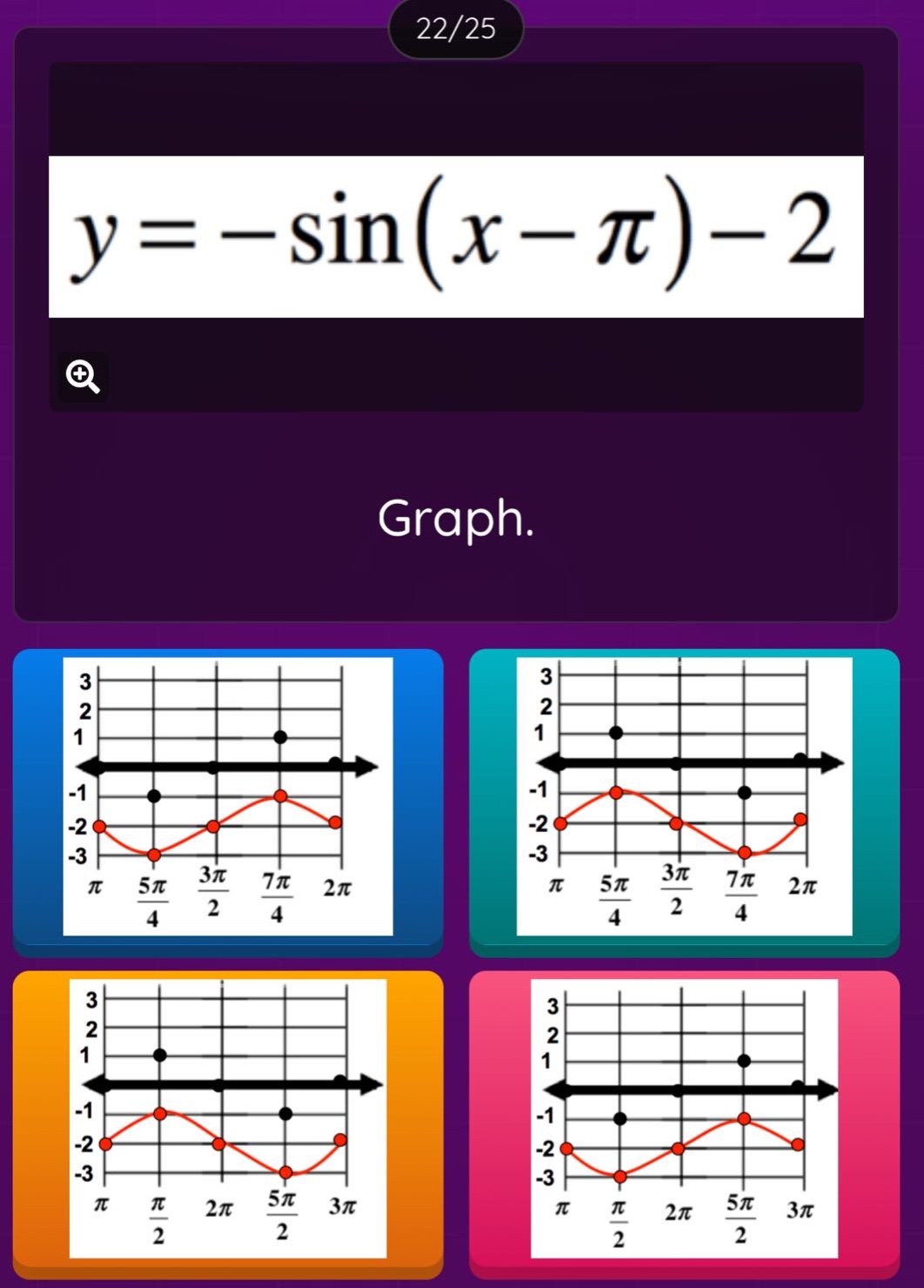
y = -\\sin(x - \\pi)-2\ngraph.
Answer
Explanation:
Step1: Use trigonometric identity
We know that $\sin(A - B)=\sin A\cos B-\cos A\sin B$. For $\sin(x - \pi)=\sin x\cos\pi-\cos x\sin\pi$. Since $\cos\pi=- 1$ and $\sin\pi = 0$, then $\sin(x - \pi)=-\sin x$. So the function $y =-\sin(x - \pi)-2$ becomes $y=\sin x-2$.
Step2: Analyze key - points of $y = \sin x$
The standard sine - function $y=\sin x$ has a period of $2\pi$, an amplitude of $1$, and key - points: when $x = 0,y = 0$; when $x=\frac{\pi}{2},y = 1$; when $x=\pi,y = 0$; when $x=\frac{3\pi}{2},y=-1$; when $x = 2\pi,y = 0$.
Step3: Analyze key - points of $y=\sin x-2$
For the function $y=\sin x-2$, we shift the graph of $y = \sin x$ down by 2 units. So the key - points are: when $x = 0,y=-2$; when $x=\frac{\pi}{2},y=-1$; when $x=\pi,y=-2$; when $x=\frac{3\pi}{2},y=-3$; when $x = 2\pi,y=-2$.
Step4: Match the graph
We check the given options for a sine - like curve with an amplitude of 1, a period of $2\pi$, and shifted down by 2 units.
Answer:
We need to visually inspect the graphs in the options. The graph of $y=\sin x-2$ will have a maximum value of $y=-1$ (when $\sin x = 1$), a minimum value of $y=-3$ (when $\sin x=-1$), and will cross the $y$ - axis at $y = - 2$. Without explicitly naming the options, the correct graph is the one that has these characteristics.