if sin θ = 5/6, θ in quadrant ii, find the exact value of (a) cos θ (b) sin(θ + π/6) (c) cos(θ - π/3) (d)…
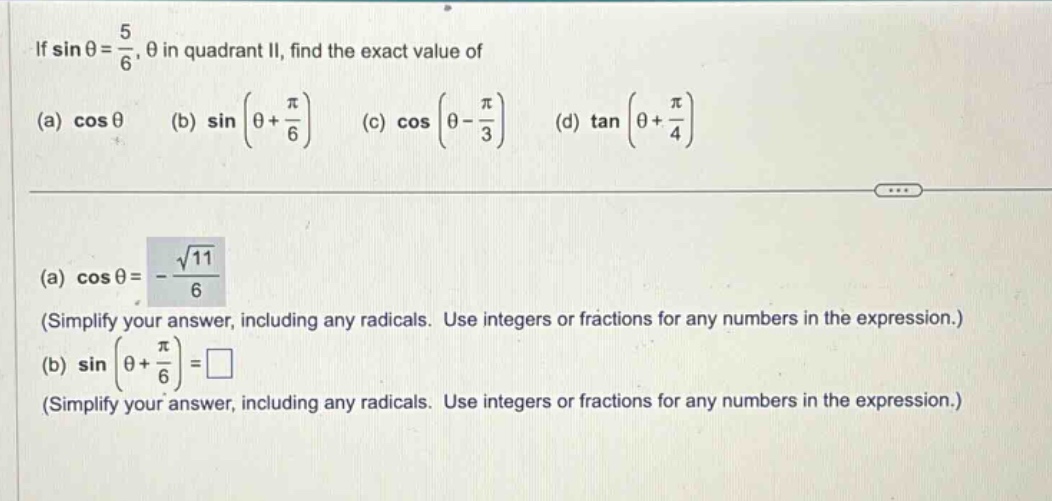
if sin θ = 5/6, θ in quadrant ii, find the exact value of (a) cos θ (b) sin(θ + π/6) (c) cos(θ - π/3) (d) tan(θ + π/4) (a) cos θ = -√11/6 (simplify your answer, including any radicals. use integers or fractions for any numbers in the expression.) (b) sin(θ + π/6) = □ (simplify your answer, including any radicals. use integers or fractions for any numbers in the expression.)
Answer
Explanation:
Step1: Recall the Pythagorean identity
We know that $\sin^{2}\theta+\cos^{2}\theta = 1$. Given $\sin\theta=\frac{5}{6}$, then $\cos^{2}\theta=1 - \sin^{2}\theta=1-\left(\frac{5}{6}\right)^{2}=1-\frac{25}{36}=\frac{36 - 25}{36}=\frac{11}{36}$, so $\cos\theta=\pm\frac{\sqrt{11}}{6}$. Since $\theta$ is in quadrant II where cosine is negative, $\cos\theta=-\frac{\sqrt{11}}{6}$.
Step2: Use the sum - of - angles formula for sine
The formula for $\sin(A + B)=\sin A\cos B+\cos A\sin B$. For $\sin\left(\theta+\frac{\pi}{6}\right)$, we have $A = \theta$ and $B=\frac{\pi}{6}$. We know that $\sin\theta=\frac{5}{6}$ and $\cos\theta=-\frac{\sqrt{11}}{6}$, $\sin\frac{\pi}{6}=\frac{1}{2}$ and $\cos\frac{\pi}{6}=\frac{\sqrt{3}}{2}$. Then $\sin\left(\theta+\frac{\pi}{6}\right)=\sin\theta\cos\frac{\pi}{6}+\cos\theta\sin\frac{\pi}{6}=\frac{5}{6}\times\frac{\sqrt{3}}{2}+\left(-\frac{\sqrt{11}}{6}\right)\times\frac{1}{2}=\frac{5\sqrt{3}-\sqrt{11}}{12}$.
Step3: Use the difference - of - angles formula for cosine
The formula for $\cos(A - B)=\cos A\cos B+\sin A\sin B$. For $\cos\left(\theta-\frac{\pi}{3}\right)$, with $A = \theta$ and $B=\frac{\pi}{3}$, $\cos\theta=-\frac{\sqrt{11}}{6}$, $\sin\theta=\frac{5}{6}$, $\cos\frac{\pi}{3}=\frac{1}{2}$ and $\sin\frac{\pi}{3}=\frac{\sqrt{3}}{2}$. Then $\cos\left(\theta - \frac{\pi}{3}\right)=\cos\theta\cos\frac{\pi}{3}+\sin\theta\sin\frac{\pi}{3}=-\frac{\sqrt{11}}{6}\times\frac{1}{2}+\frac{5}{6}\times\frac{\sqrt{3}}{2}=\frac{5\sqrt{3}-\sqrt{11}}{12}$.
Step4: Use the sum - of - angles formula for tangent
The formula for $\tan(A + B)=\frac{\tan A+\tan B}{1 - \tan A\tan B}$. First, $\tan\theta=\frac{\sin\theta}{\cos\theta}=\frac{\frac{5}{6}}{-\frac{\sqrt{11}}{6}}=-\frac{5}{\sqrt{11}}$, and $\tan\frac{\pi}{4}=1$. Then $\tan\left(\theta+\frac{\pi}{4}\right)=\frac{\tan\theta+\tan\frac{\pi}{4}}{1-\tan\theta\tan\frac{\pi}{4}}=\frac{-\frac{5}{\sqrt{11}} + 1}{1-\left(-\frac{5}{\sqrt{11}}\right)\times1}=\frac{\sqrt{11}- 5}{\sqrt{11}+5}=\frac{(\sqrt{11}-5)^{2}}{(\sqrt{11}+5)(\sqrt{11}-5)}=\frac{11-10\sqrt{11}+25}{11 - 25}=\frac{36-10\sqrt{11}}{-14}=\frac{5\sqrt{11}-18}{7}$.
Answer:
(b) $\frac{5\sqrt{3}-\sqrt{11}}{12}$ (c) $\frac{5\sqrt{3}-\sqrt{11}}{12}$ (d) $\frac{5\sqrt{11}-18}{7}$