if \\( \\sin \\theta = \\frac { 4 } { \\sqrt { 29 } } \\) and angle \\( \\theta \\) is in quadrant i, what…
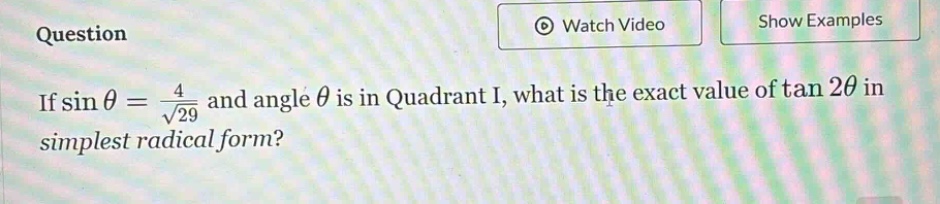
if \\( \\sin \\theta = \\frac { 4 } { \\sqrt { 29 } } \\) and angle \\( \\theta \\) is in quadrant i, what is the exact value of \\( \\tan 2 \\theta \\) in simplest radical form?
Answer
Explanation:
Step1: Find (\cos\theta)
Using the Pythagorean identity (\sin^{2}\theta+\cos^{2}\theta = 1). Given (\sin\theta=\frac{4}{\sqrt{29}}), then (\cos^{2}\theta=1-\sin^{2}\theta). [ \begin{align*} \cos^{2}\theta&=1 - (\frac{4}{\sqrt{29}})^2\ &=1-\frac{16}{29}\ &=\frac{29 - 16}{29}\ &=\frac{13}{29} \end{align*} ] Since (\theta) is in Quadrant I, (\cos\theta=\frac{\sqrt{13}}{\sqrt{29}}).
Step2: Find (\tan\theta)
Using the formula (\tan\theta=\frac{\sin\theta}{\cos\theta}). [ \begin{align*} \tan\theta&=\frac{\frac{4}{\sqrt{29}}}{\frac{\sqrt{13}}{\sqrt{29}}}\ &=\frac{4}{\sqrt{13}} \end{align*} ]
Step3: Find (\tan2\theta)
Using the double - angle formula (\tan2\theta=\frac{2\tan\theta}{1-\tan^{2}\theta}). Substitute (\tan\theta = \frac{4}{\sqrt{13}}) into the formula: [ \begin{align*} \tan2\theta&=\frac{2\times\frac{4}{\sqrt{13}}}{1-(\frac{4}{\sqrt{13}})^2}\ &=\frac{\frac{8}{\sqrt{13}}}{1-\frac{16}{13}}\ &=\frac{\frac{8}{\sqrt{13}}}{\frac{13 - 16}{13}}\ &=\frac{\frac{8}{\sqrt{13}}}{-\frac{3}{13}}\ &=\frac{8}{\sqrt{13}}\times(-\frac{13}{3})\ &=-\frac{8\sqrt{13}}{3} \end{align*} ]
Answer:
(-\frac{8\sqrt{13}}{3})