since 1 / (1 - t^12) = sum(n = 0 to infinity)(t^12n), a power series representation of t / (1 - t^12) = t(1…
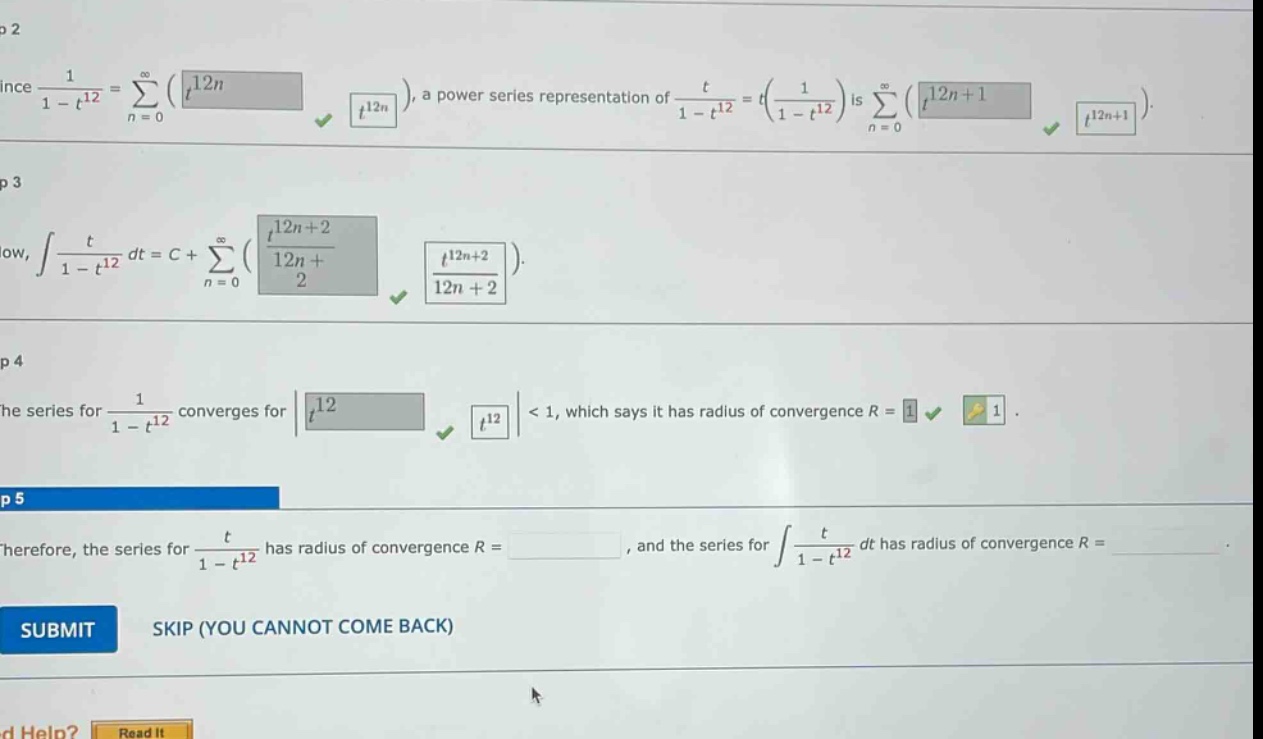
since 1 / (1 - t^12) = sum(n = 0 to infinity)(t^12n), a power series representation of t / (1 - t^12) = t(1 / (1 - t^12)) is sum(n = 0 to infinity)(t^12n + 1). now, integral t / (1 - t^12) dt = c + sum(n = 0 to infinity)(t^12n + 2 / (12n + 2)). the series for 1 / (1 - t^12) converges for |t^12| < 1, which says it has radius of convergence r = 1. therefore, the series for t / (1 - t^12) has radius of convergence r =, and the series for integral t / (1 - t^12) dt has radius of convergence r = submit skip (you cannot come back) need help? read it
Answer
Explanation:
Step1: Recall power - series property
If the power series of $\frac{1}{1 - u}=\sum_{n = 0}^{\infty}u^{n}$ with radius of convergence $R = 1$ for $|u|<1$. Let $u=t^{12}$, then the power series of $\frac{1}{1 - t^{12}}=\sum_{n = 0}^{\infty}t^{12n}$ has radius of convergence $R = 1$ since $|t^{12}|<1$ implies $|t|<1$.
Step2: Analyze the series of $\frac{t}{1 - t^{12}}$
The series of $\frac{t}{1 - t^{12}}=t\cdot\frac{1}{1 - t^{12}}=\sum_{n = 0}^{\infty}t^{12n + 1}$. When multiplying a power - series by a non - zero polynomial (in this case, the polynomial is $t$), the radius of convergence does not change. So the radius of convergence of $\sum_{n = 0}^{\infty}t^{12n+1}$ is the same as that of $\sum_{n = 0}^{\infty}t^{12n}$, which is $R = 1$.
Step3: Analyze the series of $\int\frac{t}{1 - t^{12}}dt$
The radius of convergence of the power series of an antiderivative of a power - series is the same as the radius of convergence of the original power series. Since $\int\frac{t}{1 - t^{12}}dt=C+\sum_{n = 0}^{\infty}\frac{t^{12n + 2}}{12n+2}$, and the radius of convergence of $\sum_{n = 0}^{\infty}t^{12n+1}$ is $R = 1$, the radius of convergence of $\sum_{n = 0}^{\infty}\frac{t^{12n + 2}}{12n+2}$ is also $R = 1$.
Answer:
1, 1