the size p of a certain insect population at time t (in days) obeys the function p(t)=700e^{0.05t}. (a)…
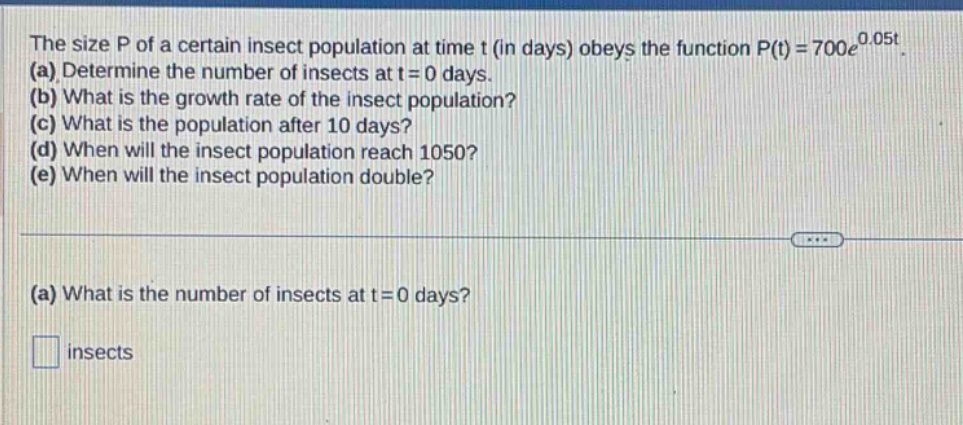
the size p of a certain insect population at time t (in days) obeys the function p(t)=700e^{0.05t}. (a) determine the number of insects at t = 0 days. (b) what is the growth rate of the insect population? (c) what is the population after 10 days? (d) when will the insect population reach 1050? (e) when will the insect population double? (a) what is the number of insects at t = 0 days? insects
Answer
Explanation:
Step1: Substitute t = 0
Substitute $t = 0$ into $P(t)=700e^{0.05t}$. $P(0)=700e^{0.05\times0}$
Step2: Simplify the exponent
Since $0.05\times0 = 0$, and $e^0=1$, we have: $P(0)=700\times1 = 700$
Step3: Find the growth - rate
The general form of an exponential growth function is $P(t)=P_0e^{rt}$, where $r$ is the growth rate. In $P(t)=700e^{0.05t}$, the growth rate $r = 0.05$ or $5%$.
Step4: Find population at t = 10
Substitute $t = 10$ into $P(t)=700e^{0.05t}$. $P(10)=700e^{0.05\times10}=700e^{0.5}$ Using a calculator, $e^{0.5}\approx1.64872$, so $P(10)=700\times1.64872 = 1154.104\approx1154$.
Step5: Solve for t when P(t)=1050
Set $P(t)=1050$, so $1050 = 700e^{0.05t}$. First, divide both sides by 700: $\frac{1050}{700}=e^{0.05t}$, which simplifies to $1.5 = e^{0.05t}$. Then take the natural - logarithm of both sides: $\ln(1.5)=\ln(e^{0.05t})$. Since $\ln(e^{x})=x$, we have $\ln(1.5)=0.05t$. Solve for $t$: $t=\frac{\ln(1.5)}{0.05}$. Using a calculator, $\ln(1.5)\approx0.4055$, so $t=\frac{0.4055}{0.05}=8.11\approx8.1$ days.
Step6: Solve for t when population doubles
The initial population $P_0 = 700$. When the population doubles, $P(t)=1400$. Set $1400 = 700e^{0.05t}$. Divide both sides by 700: $2 = e^{0.05t}$. Take the natural - logarithm of both sides: $\ln(2)=\ln(e^{0.05t})$. Since $\ln(e^{x})=x$, we have $\ln(2)=0.05t$. Solve for $t$: $t=\frac{\ln(2)}{0.05}$. Using a calculator, $\ln(2)\approx0.6931$, so $t=\frac{0.6931}{0.05}=13.862\approx13.9$ days.
Answer:
(a) 700 insects (b) 5% (c) 1154 insects (d) 8.1 days (e) 13.9 days