sketch and describe the solid that is produced when the region enclosed by the given equations is rotated…
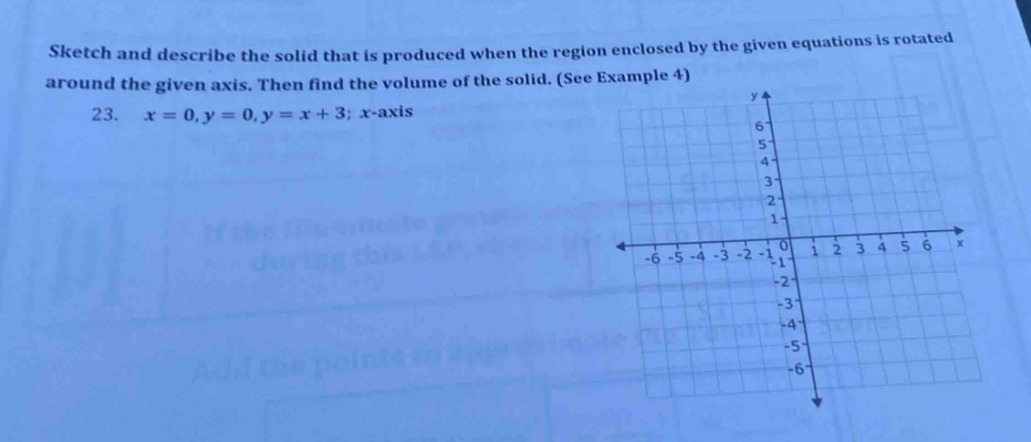
sketch and describe the solid that is produced when the region enclosed by the given equations is rotated around the given axis. then find the volume of the solid. (see example 4) 23. x = 0,y = 0,y = x + 3; x - axis
Answer
Explanation:
Step1: Identify the region
The region is bounded by (x = 0), (y=0) and (y=x + 3). It is a right - triangle in the first - quadrant with vertices ((0,0)), ((0,3)) and ((- 3,0)) (but we are in the first - quadrant, so we consider the part where (x\geq0) and (y\geq0)). When rotated about the (x) - axis, it forms a cone.
Step2: Use the disk method formula
The formula for the volume (V) of a solid of revolution using the disk method when rotating about the (x) - axis is (V=\pi\int_{a}^{b}[f(x)]^{2}dx). Here, (y = f(x)=x + 3), and the limits of integration are found by setting (y = 0) and (x=0). The line (y=x + 3) intersects (x = 0) at (y=3) and (y = 0) at (x=-3). Since we are in the first - quadrant, we integrate from (x = 0) to (x=-3). The formula becomes (V=\pi\int_{0}^{-3}(x + 3)^{2}dx). Expand ((x + 3)^{2}=x^{2}+6x + 9).
Step3: Integrate term - by - term
(\int(x^{2}+6x + 9)dx=\frac{x^{3}}{3}+3x^{2}+9x+C).
Step4: Evaluate the definite integral
(V=\pi\left[\frac{x^{3}}{3}+3x^{2}+9x\right]_{0}^{-3}). [ \begin{align*} V&=\pi\left(\frac{(-3)^{3}}{3}+3(-3)^{2}+9(-3)-0\right)\ &=\pi\left(-9 + 27-27\right)\ &=9\pi \end{align*} ]
Answer:
The solid is a cone. The volume of the solid is (9\pi) cubic units.