2. sketch the following piece - wise functions and justify all discontinuities using limits.\na)…
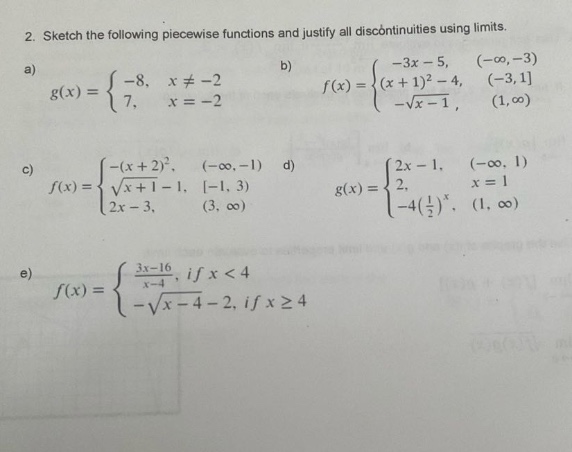
2. sketch the following piece - wise functions and justify all discontinuities using limits.\na) (g(x)=\begin{cases}-8, & x\neq - 2\\7, & x = - 2end{cases}) b) (f(x)=\begin{cases}-3x - 5, & (-infty,-3)\\(x + 1)^{2}-4, & (-3,1)\\-sqrt{x - 1}, & (1,infty)end{cases})\nc) (f(x)=\begin{cases}-(x + 2)^{2}, & (-infty,-1)\\sqrt{x + 1}-1, & -1,3)\\2x - 3, & (3,infty)end{cases}) d) (g(x)=\begin{cases}2x - 1, & (-infty,1)\\2, & x = 1\\-4(\frac{1}{2})^{x}, & (1,infty)end{cases})\ne) (f(x)=\begin{cases}\frac{3x - 16}{x - 4}, & if xlt4\\-sqrt{x - 4}-2, & if xgeq4end{cases})
Answer
Explanation:
Step1: Analyze function a) $g(x)$
For $x\neq - 2$, $g(x)=-8$. For $x = - 2$, $g(x)=7$. $\lim_{x\rightarrow - 2^{-}}g(x)=-8$ and $\lim_{x\rightarrow - 2^{+}}g(x)=-8$, but $g(-2) = 7$. Since $\lim_{x\rightarrow - 2}g(x)=-8\neq g(-2)$, there is a jump - discontinuity at $x=-2$. To sketch, draw a horizontal line $y = - 8$ with a hole at $x=-2$ and a point at $(-2,7)$.
Step2: Analyze function b) $f(x)$
- For $x\in(-\infty,-3)$: $y=-3x - 5$.
- For $x\in(-3,1)$: $y=(x + 1)^{2}-4=x^{2}+2x - 3$.
- For $x\in(1,\infty)$: $y=-\sqrt{x - 1}$.
- At $x=-3$: $\lim_{x\rightarrow - 3^{-}}(-3x - 5)=4$, $\lim_{x\rightarrow - 3^{+}}(x^{2}+2x - 3)=0$. There is a jump - discontinuity at $x=-3$.
- At $x = 1$: $\lim_{x\rightarrow 1^{-}}(x^{2}+2x - 3)=0$, $\lim_{x\rightarrow 1^{+}}(-\sqrt{x - 1})=0$. Also, $f(1)$ is not defined in the piece - wise function. There is a removable discontinuity at $x = 1$. To sketch, draw the line $y=-3x - 5$ for $x\lt - 3$, the parabola $y=x^{2}+2x - 3$ for $-3\lt x\lt1$ and the half - parabola $y=-\sqrt{x - 1}$ for $x\gt1$ with appropriate holes and non - existent points.
Step3: Analyze function c) $f(x)$
- For $x\in(-\infty,-1)$: $y=-(x + 2)^{2}$.
- For $x\in[-1,3)$: $y=\sqrt{x + 1}-1$.
- For $x\in(3,\infty)$: $y=2x - 3$.
- At $x=-1$: $\lim_{x\rightarrow - 1^{-}}-(x + 2)^{2}=-1$, $\lim_{x\rightarrow - 1^{+}}\sqrt{x + 1}-1=-1$. The function is continuous at $x=-1$.
- At $x = 3$: $\lim_{x\rightarrow 3^{-}}\sqrt{x + 1}-1=1$, $\lim_{x\rightarrow 3^{+}}2x - 3=3$. There is a jump - discontinuity at $x = 3$. To sketch, draw the parabola $y=-(x + 2)^{2}$ for $x\lt - 1$, the curve $y=\sqrt{x + 1}-1$ for $-1\leq x\lt3$ and the line $y=2x - 3$ for $x\gt3$.
Step4: Analyze function d) $g(x)$
- For $x\in(-\infty,1)$: $y=2x - 1$.
- For $x = 1$: $y = 2$.
- For $x\in(1,\infty)$: $y=-4(\frac{1}{2})^{x}$.
- $\lim_{x\rightarrow 1^{-}}(2x - 1)=1$, $\lim_{x\rightarrow 1^{+}}-4(\frac{1}{2})^{x}=-2$, $g(1)=2$. There are discontinuities at $x = 1$. The left - hand limit, right - hand limit and the function value at $x = 1$ are all different. To sketch, draw the line $y=2x - 1$ for $x\lt1$, a point at $(1,2)$ and the exponential decay curve $y=-4(\frac{1}{2})^{x}$ for $x\gt1$.
Step5: Analyze function e) $f(x)$
- For $x\lt4$: $y=\frac{3x - 16}{x - 4}=\frac{3(x - 4)-4}{x - 4}=3-\frac{4}{x - 4}$.
- For $x\geq4$: $y=-\sqrt{x - 4}-2$.
- $\lim_{x\rightarrow 4^{-}}\frac{3x - 16}{x - 4}=-\infty$, so there is an infinite discontinuity at $x = 4$. To sketch, draw the hyperbola $y = 3-\frac{4}{x - 4}$ for $x\lt4$ and the half - parabola $y=-\sqrt{x - 4}-2$ for $x\geq4$.
Answer:
The discontinuities and sketches are as described above for each of the piece - wise functions a), b), c), d) and e).