4. sketch the following quadric surface.\n\n$$y^2 = 4x^2 + 16z^2$$
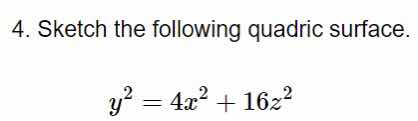
4. sketch the following quadric surface.\n\n$$y^2 = 4x^2 + 16z^2$$
Answer
Explanation:
Step1: Identify the quadric surface type
The equation $y^2 = 4x^2 + 16z^2$ represents an elliptic cone opening along the $y$-axis.
Step2: Determine traces in coordinate planes
In the $xz$-plane ($y=0$), the trace is the point $(0,0,0)$. In the $xy$-plane ($z=0$), the traces are lines $y = \pm 2x$. In the $yz$-plane ($x=0$), the traces are lines $y = \pm 4z$.
Step3: Determine horizontal traces (cross-sections)
For constant $y = k$, the cross-sections are ellipses: $\frac{x^2}{(k/2)^2} + \frac{z^2}{(k/4)^2} = 1$.
Step4: Describe the sketch
The surface consists of two nappes meeting at the origin, expanding as ellipses along the positive and negative $y$-axis.
Answer:
The quadric surface $y^2 = 4x^2 + 16z^2$ is an elliptic cone centered at the origin and opening along the $y$-axis. To sketch it, plot the vertex at $(0,0,0)$, draw the linear traces $y = \pm 2x$ in the $xy$-plane and $y = \pm 4z$ in the $yz$-plane, and then draw elliptical cross-sections perpendicular to the $y$-axis for various values of $y$ (e.g., at $y=4$, the ellipse is $x^2 + 4z^2 = 4$).