1. sketch the following quadric surface.\n$$\\frac{y^2}{9} + z^2 = 1$$
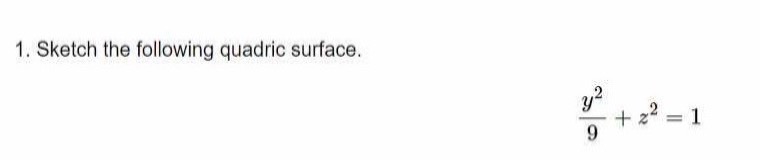
1. sketch the following quadric surface.\n$$\\frac{y^2}{9} + z^2 = 1$$
Answer
Explanation:
Step1: Identify the surface type
The equation $\frac{y^2}{9} + z^2 = 1$ lacks the $x$ variable, representing a cylinder.
Step2: Analyze the cross-section
In the $yz$-plane, the equation $\frac{y^2}{3^2} + \frac{z^2}{1^2} = 1$ defines an ellipse.
Step3: Determine the orientation
The ellipse has vertices at $(0, \pm 3, 0)$ and $(0, 0, \pm 1)$.
Step4: Extend along the missing axis
Since $x$ is arbitrary, the elliptical cross-section extends infinitely along the $x$-axis.
Answer:
The quadric surface is an elliptical cylinder centered on the $x$-axis. To sketch it, draw an ellipse in the $yz$-plane with a major axis of length 6 along the $y$-axis (from $-3$ to $3$) and a minor axis of length 2 along the $z$-axis (from $-1$ to $1$). Then, extend this elliptical shape infinitely in both the positive and negative directions of the $x$-axis to form a tube-like surface.