3. sketch the following quadric surface.\n\n$$z = \\frac{x^2}{4} + \\frac{y^2}{4} - 6$$
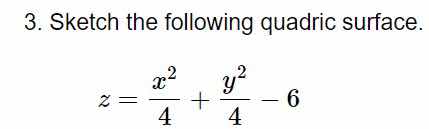
3. sketch the following quadric surface.\n\n$$z = \\frac{x^2}{4} + \\frac{y^2}{4} - 6$$
Answer
Explanation:
Step1: Identify the quadric surface type
The equation $z = \frac{x^2}{4} + \frac{y^2}{4} - 6$ represents a circular paraboloid.
Step2: Determine the vertex of the paraboloid
Setting $x=0$ and $y=0$ gives the lowest point. $$z = \frac{0^2}{4} + \frac{0^2}{4} - 6 = -6$$ Vertex: $(0, 0, -6)$.
Step3: Analyze horizontal traces (cross-sections)
For $z = k$ (where $k > -6$), the traces are circles. $$k + 6 = \frac{x^2 + y^2}{4} \implies x^2 + y^2 = 4(k + 6)$$
Step4: Analyze vertical traces
Traces in $x=0$ or $y=0$ planes are parabolas. $$z = \frac{y^2}{4} - 6 \text{ (in } yz\text{-plane)}, \quad z = \frac{x^2}{4} - 6 \text{ (in } xz\text{-plane)}$$
Step5: Find intercepts with the xy-plane
Set $z=0$ to find the intersection with the $xy$-plane. $$0 = \frac{x^2+y^2}{4} - 6 \implies x^2 + y^2 = 24$$
Answer:
The surface is a circular paraboloid opening upwards with its vertex at $(0, 0, -6)$. To sketch it, plot the vertex at $(0, 0, -6)$ on the $z$-axis. Draw a bowl-shaped surface where horizontal cross-sections are circles centered on the $z$-axis. The circle at $z=0$ (the $xy$-plane) has a radius of $\sqrt{24} \approx 4.9$. Vertical cross-sections through the $z$-axis are parabolas opening upwards.