sketch the graph of y = x^4 - 5x^2 - 14. identify the intervals on which it is increasing, decreasing…
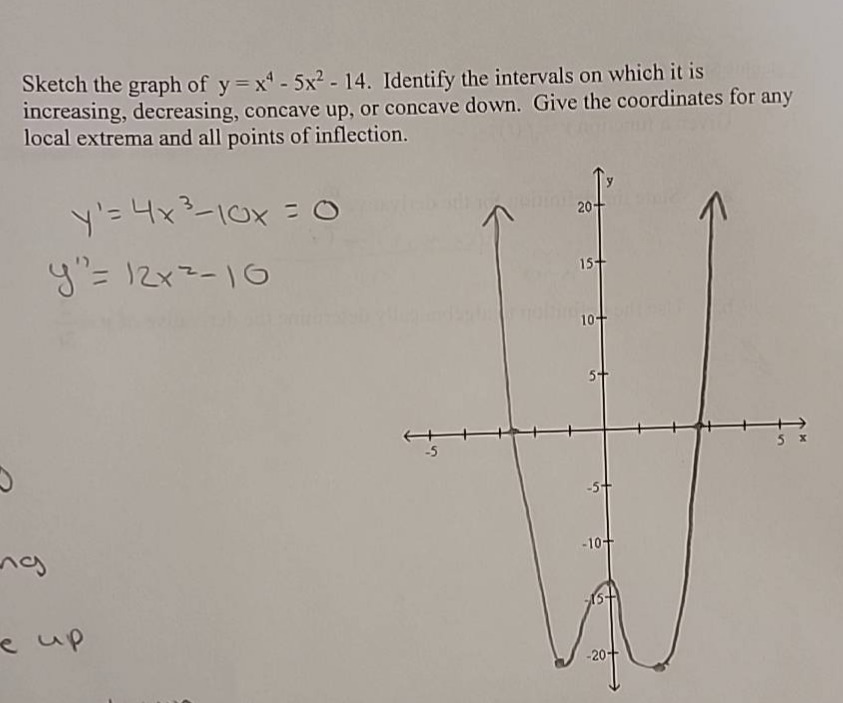
sketch the graph of y = x^4 - 5x^2 - 14. identify the intervals on which it is increasing, decreasing, concave up, or concave down. give the coordinates for any local extrema and all points of inflection.\ny = 4x^3 - 10x = 0\ny = 12x^2 - 10
Answer
Explanation:
Step1: Find critical points
Set $y' = 4x^{3}-10x=2x(2x^{2} - 5)=0$. Then $2x=0$ or $2x^{2}-5 = 0$. Solving $2x=0$ gives $x = 0$, and solving $2x^{2}-5=0$ gives $x=\pm\frac{\sqrt{10}}{2}$.
Step2: Determine increasing - decreasing intervals
Test intervals: For $x<-\frac{\sqrt{10}}{2}$, let $x=-2$, then $y'=4(-2)^{3}-10(-2)=-32 + 20=-12<0$, so the function is decreasing. For $-\frac{\sqrt{10}}{2}<x<0$, let $x = - 1$, then $y'=4(-1)^{3}-10(-1)=-4 + 10 = 6>0$, so the function is increasing. For $0<x<\frac{\sqrt{10}}{2}$, let $x = 1$, then $y'=4(1)^{3}-10(1)=4 - 10=-6<0$, so the function is decreasing. For $x>\frac{\sqrt{10}}{2}$, let $x = 2$, then $y'=4(2)^{3}-10(2)=32 - 20 = 12>0$, so the function is increasing.
Step3: Find local extrema
Evaluate the function at critical points. $y(-\frac{\sqrt{10}}{2})=(-\frac{\sqrt{10}}{2})^{4}-5(-\frac{\sqrt{10}}{2})^{2}-14=\frac{100}{16}-\frac{50}{4}-14=\frac{100 - 200 - 224}{16}=-\frac{324}{16}=-\frac{81}{4}$, $y(0)=-14$, $y(\frac{\sqrt{10}}{2})=(\frac{\sqrt{10}}{2})^{4}-5(\frac{\sqrt{10}}{2})^{2}-14=-\frac{81}{4}$. So local minima are $(-\frac{\sqrt{10}}{2},-\frac{81}{4})$ and $(\frac{\sqrt{10}}{2},-\frac{81}{4})$, local maximum is $(0,-14)$.
Step4: Find points of inflection
Set $y''=12x^{2}-10 = 0$. Then $12x^{2}=10$, $x^{2}=\frac{10}{12}=\frac{5}{6}$, $x=\pm\frac{\sqrt{30}}{6}$.
Step5: Determine concavity
For $x<-\frac{\sqrt{30}}{6}$, let $x=-1$, then $y''=12(-1)^{2}-10 = 2>0$, so the function is concave up. For $-\frac{\sqrt{30}}{6}<x<\frac{\sqrt{30}}{6}$, let $x = 0$, then $y''=-10<0$, so the function is concave down. For $x>\frac{\sqrt{30}}{6}$, let $x = 1$, then $y''=12(1)^{2}-10 = 2>0$, so the function is concave up.
Increasing intervals: $(-\frac{\sqrt{10}}{2},0)\cup(\frac{\sqrt{10}}{2},\infty)$; Decreasing intervals: $(-\infty,-\frac{\sqrt{10}}{2})\cup(0,\frac{\sqrt{10}}{2})$; Concave - up intervals: $(-\infty,-\frac{\sqrt{30}}{6})\cup(\frac{\sqrt{30}}{6},\infty)$; Concave - down interval: $(-\frac{\sqrt{30}}{6},\frac{\sqrt{30}}{6})$; Local minima: $(-\frac{\sqrt{10}}{2},-\frac{81}{4})$, $(\frac{\sqrt{10}}{2},-\frac{81}{4})$; Local maximum: $(0,-14)$; Points of inflection: $(-\frac{\sqrt{30}}{6},y(-\frac{\sqrt{30}}{6}))$ and $(\frac{\sqrt{30}}{6},y(\frac{\sqrt{30}}{6}))$ where $y(\pm\frac{\sqrt{30}}{6})=(\pm\frac{\sqrt{30}}{6})^{4}-5(\pm\frac{\sqrt{30}}{6})^{2}-14=\frac{900}{1296}-\frac{150}{36}-14=\frac{900 - 5400 - 18664}{1296}=-\frac{23164}{1296}=-\frac{5791}{324}$.
Answer:
Increasing intervals: $(-\frac{\sqrt{10}}{2},0)\cup(\frac{\sqrt{10}}{2},\infty)$; Decreasing intervals: $(-\infty,-\frac{\sqrt{10}}{2})\cup(0,\frac{\sqrt{10}}{2})$; Concave - up intervals: $(-\infty,-\frac{\sqrt{30}}{6})\cup(\frac{\sqrt{30}}{6},\infty)$; Concave - down interval: $(-\frac{\sqrt{30}}{6},\frac{\sqrt{30}}{6})$; Local minima: $(-\frac{\sqrt{10}}{2},-\frac{81}{4})$, $(\frac{\sqrt{10}}{2},-\frac{81}{4})$; Local maximum: $(0,-14)$; Points of inflection: $(-\frac{\sqrt{30}}{6},-\frac{5791}{324})$, $(\frac{\sqrt{30}}{6},-\frac{5791}{324})$