sketch the graph of a differentiable function y = f(x) through the point (-4,4) if f(-4)=0 and satisfies the…
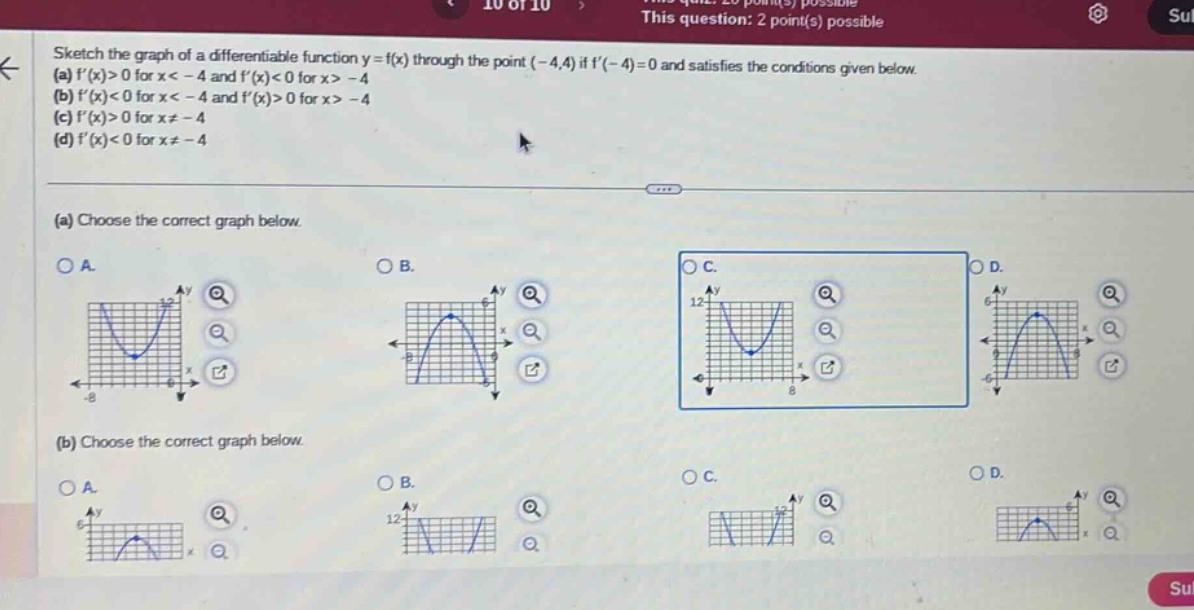
sketch the graph of a differentiable function y = f(x) through the point (-4,4) if f(-4)=0 and satisfies the conditions given below. (a) f(x)>0 for x < -4 and f(x)<0 for x > -4 (b) f(x)<0 for x < -4 and f(x)>0 for x > -4 (c) f(x)>0 for x≠ -4 (d) f(x)<0 for x≠ -4 (a) choose the correct graph below. (b) choose the correct graph below.
Answer
Explanation:
Step1: Recall derivative - function relationship
The sign of the derivative $f^{\prime}(x)$ determines the increasing - decreasing nature of the function $y = f(x)$. If $f^{\prime}(x)>0$, the function is increasing; if $f^{\prime}(x)<0$, the function is decreasing. Also, $f^{\prime}(a) = 0$ indicates a possible local extremum at $x = a$.
Step2: Analyze part (a)
Given $f^{\prime}(-4)=0$, $f^{\prime}(x)>0$ for $x < - 4$ and $f^{\prime}(x)<0$ for $x>-4$. This means the function is increasing on the interval $(-\infty,-4)$ and decreasing on the interval $(-4,\infty)$. So, the function has a local maximum at $x = - 4$. The graph that represents this is a parabola opening downwards with a vertex at $(-4,4)$. So the answer for part (a) is B.
Step3: Analyze part (b)
Given $f^{\prime}(-4)=0$, $f^{\prime}(x)<0$ for $x < - 4$ and $f^{\prime}(x)>0$ for $x>-4$. This means the function is decreasing on the interval $(-\infty,-4)$ and increasing on the interval $(-4,\infty)$. So, the function has a local minimum at $x=-4$. The graph that represents this is a parabola opening upwards with a vertex at $(-4,4)$. So the answer for part (b) is A.
Step4: Analyze part (c)
Given $f^{\prime}(-4)=0$ and $f^{\prime}(x)>0$ for $x\neq - 4$. This means the function is increasing on $(-\infty,-4)\cup(-4,\infty)$. The graph has a horizontal tangent at $x = - 4$ but still increases on either side of $x=-4$. There is no local extremum. The graph is a curve that has a horizontal tangent at $(-4,4)$ and goes up on both sides, which is represented by C.
Step5: Analyze part (d)
Given $f^{\prime}(-4)=0$ and $f^{\prime}(x)<0$ for $x\neq - 4$. This means the function is decreasing on $(-\infty,-4)\cup(-4,\infty)$. The graph has a horizontal tangent at $x = - 4$ but still decreases on either side of $x=-4$. There is no local extremum. The graph is a curve that has a horizontal tangent at $(-4,4)$ and goes down on both sides, which is represented by D.
Answer:
(a) B (b) A (c) C (d) D