sketch the graph of the following function. indicate where the function is increasing or decreasing, where…
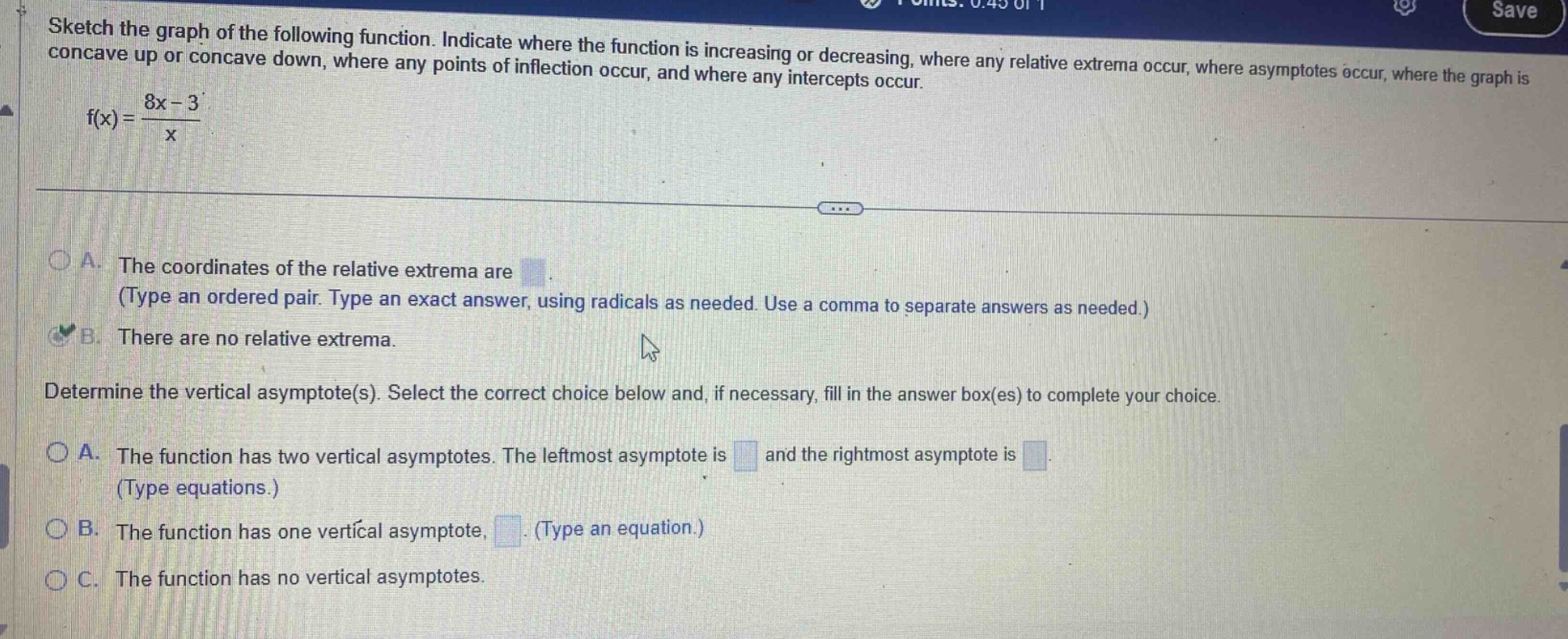
sketch the graph of the following function. indicate where the function is increasing or decreasing, where any relative extrema occur, where asymptotes occur, where the graph is concave up or concave down, where any points of inflection occur, and where any intercepts occur. f(x) = (8x - 3)/x\n\na. the coordinates of the relative extrema are (type an ordered pair. type an exact answer, using radicals as needed. use a comma to separate answers as needed.)\nb. there are no relative extrema.\n\ndetermine the vertical asymptote(s). select the correct choice below and, if necessary, fill in the answer box(es) to complete your choice.\na. the function has two vertical asymptotes. the leftmost asymptote is and the rightmost asymptote is (type equations.)\nb. the function has one vertical asymptote, (type an equation.)\nc. the function has no vertical asymptotes.
Answer
Explanation:
Step1: Rewrite the function
Rewrite $f(x)=\frac{8x - 3}{x}=8-\frac{3}{x}$.
Step2: Find the derivative
Using the power - rule, if $y = 8-3x^{-1}$, then $y'=3x^{-2}=\frac{3}{x^{2}}$. Since $y'=\frac{3}{x^{2}}>0$ for all $x\neq0$, the function has no relative extrema.
Step3: Find the vertical asymptote
Set the denominator of the original rational function equal to zero. For $y=\frac{8x - 3}{x}$, when $x = 0$, the function is undefined. So the vertical asymptote is $x = 0$.
Answer:
B. There are no relative extrema. B. The function has one vertical asymptote, $x = 0$.