sketch the graph of the following function. indicate where the function is increasing or decreasing, where…
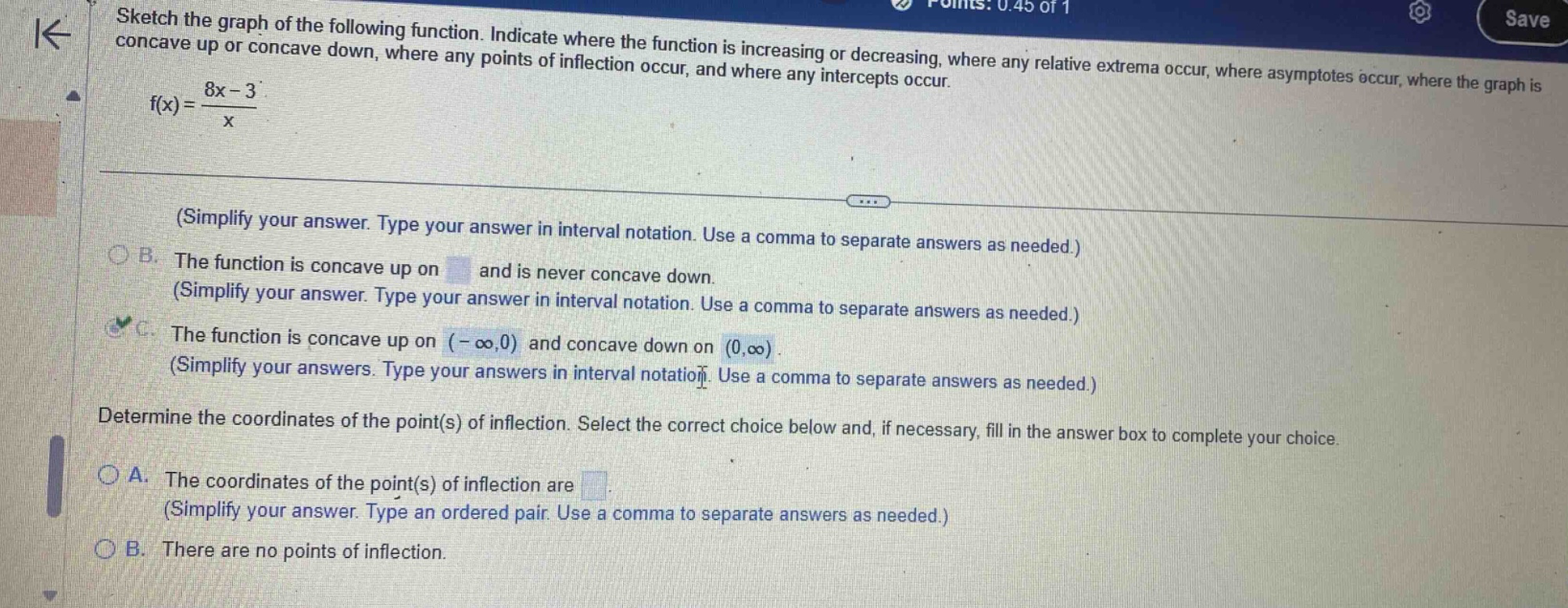
sketch the graph of the following function. indicate where the function is increasing or decreasing, where any relative extrema occur, where asymptotes occur, where the graph is concave up or concave down, where any points of inflection occur, and where any intercepts occur. f(x) = (8x - 3)/x (simplify your answer. type your answer in interval notation. use a comma to separate answers as needed.) b. the function is concave up on and is never concave down. (simplify your answer. type your answer in interval notation. use a comma to separate answers as needed.) c. the function is concave up on (-∞,0) and concave down on (0,∞). (simplify your answers. type your answers in interval notation. use a comma to separate answers as needed.) determine the coordinates of the point(s) of inflection. select the correct choice below and, if necessary, fill in the answer box to complete your choice. a. the coordinates of the point(s) of inflection are (simplify your answer. type an ordered pair. use a comma to separate answers as needed.) b. there are no points of inflection.
Answer
Explanation:
Step1: Rewrite the function
Rewrite $f(x)=\frac{8x - 3}{x}=8-\frac{3}{x}$.
Step2: Find the first - derivative
Using the power rule, if $y = 8-3x^{-1}$, then $f^\prime(x)=3x^{-2}=\frac{3}{x^{2}}$. Since $f^\prime(x)=\frac{3}{x^{2}}>0$ for all $x\neq0$, the function is increasing on $(-\infty,0)\cup(0,\infty)$.
Step3: Find the second - derivative
Differentiate $f^\prime(x)=\frac{3}{x^{2}} = 3x^{-2}$ with respect to $x$. Using the power rule, $f^{\prime\prime}(x)=-6x^{-3}=-\frac{6}{x^{3}}$.
Step4: Determine concavity
Set $f^{\prime\prime}(x)=0$, but $-\frac{6}{x^{3}} = 0$ has no solution. When $x<0$, $f^{\prime\prime}(x)>0$, so the function is concave up on $(-\infty,0)$. When $x > 0$, $f^{\prime\prime}(x)<0$, so the function is concave down on $(0,\infty)$.
Step5: Find points of inflection
A point of inflection occurs where $f^{\prime\prime}(x)$ changes sign and is continuous. Since $f(x)$ is not continuous at $x = 0$ and $f^{\prime\prime}(x)$ has no zero - value, there are no points of inflection.
Answer:
For concavity: C. The function is concave up on $(-\infty,0)$ and concave down on $(0,\infty)$. For points of inflection: B. There are no points of inflection.