sketch the graph of the following function. list the coordinates of where extrema or points of inflection…
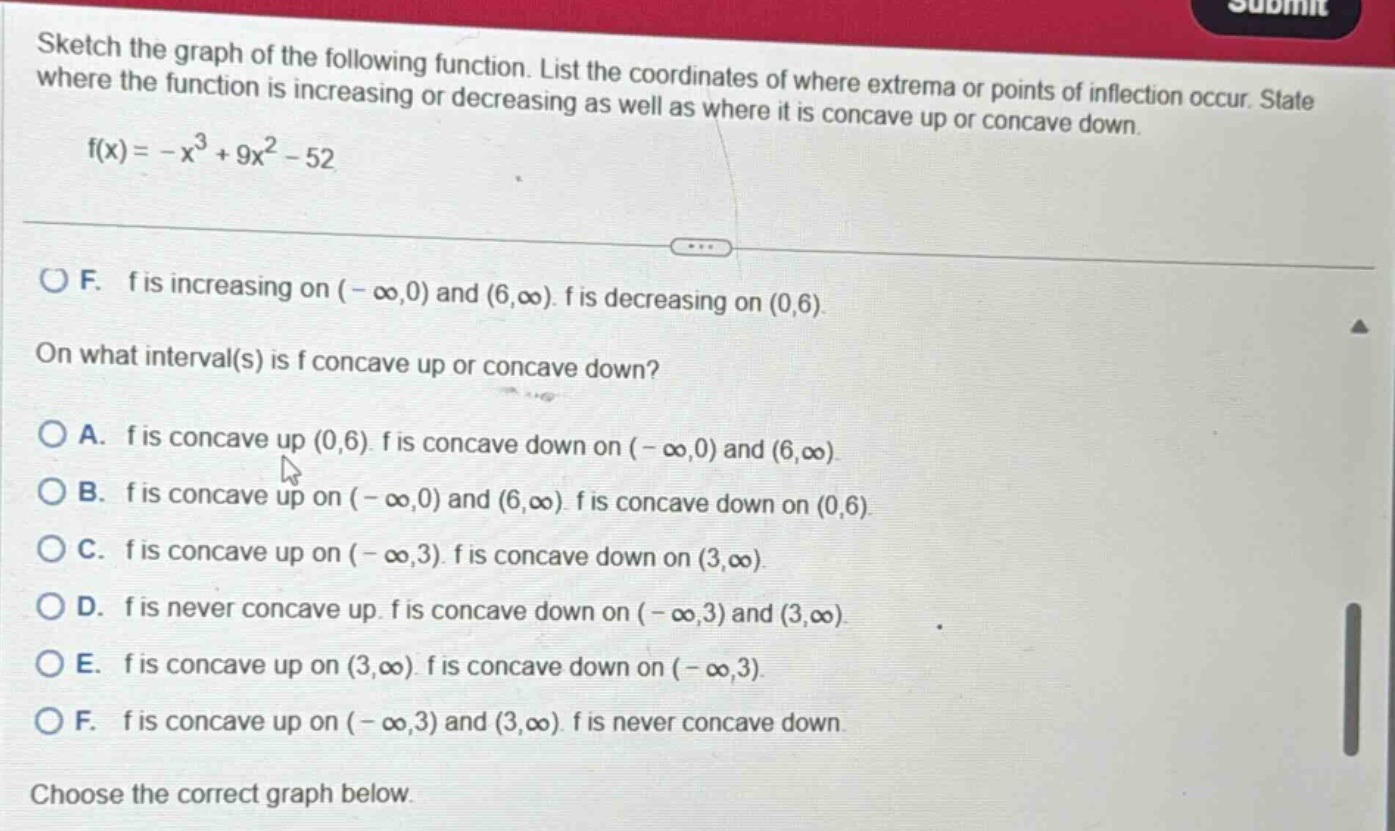
sketch the graph of the following function. list the coordinates of where extrema or points of inflection occur. state where the function is increasing or decreasing as well as where it is concave up or concave down. f(x)= -x³ + 9x² - 52\n\no f. f is increasing on (-∞,0) and (6,∞). f is decreasing on (0,6).\non what interval(s) is f concave up or concave down?\no a. f is concave up (0,6). f is concave down on (-∞,0) and (6,∞)\no b. f is concave up on (-∞,0) and (6,∞). f is concave down on (0,6)\no c. f is concave up on (-∞,3). f is concave down on (3,∞)\no d. f is never concave up. f is concave down on (-∞,3) and (3,∞)\no e. f is concave up on (3,∞). f is concave down on (-∞,3)\no f. f is concave up on (-∞,3) and (3,∞). f is never concave down.\nchoose the correct graph below.
Answer
Explanation:
Step1: Find the first - derivative
Differentiate $f(x)=-x^{3}+9x^{2}-52$ using the power rule. $f^\prime(x)=-3x^{2}+18x=-3x(x - 6)$.
Step2: Find the second - derivative
Differentiate $f^\prime(x)$ using the power rule. $f^{\prime\prime}(x)=-6x + 18=-6(x - 3)$.
Step3: Determine concavity
Set $f^{\prime\prime}(x)=0$. Then $-6(x - 3)=0$, which gives $x = 3$. When $x<3$, $f^{\prime\prime}(x)>0$, so the function is concave up on $(-\infty,3)$. When $x>3$, $f^{\prime\prime}(x)<0$, so the function is concave down on $(3,\infty)$.
Answer:
E. f is concave up on $(3,\infty)$. f is concave down on $(-\infty,3)$