sketch the graph of each function.\nf(x)=x^{3}-x^{2}+3
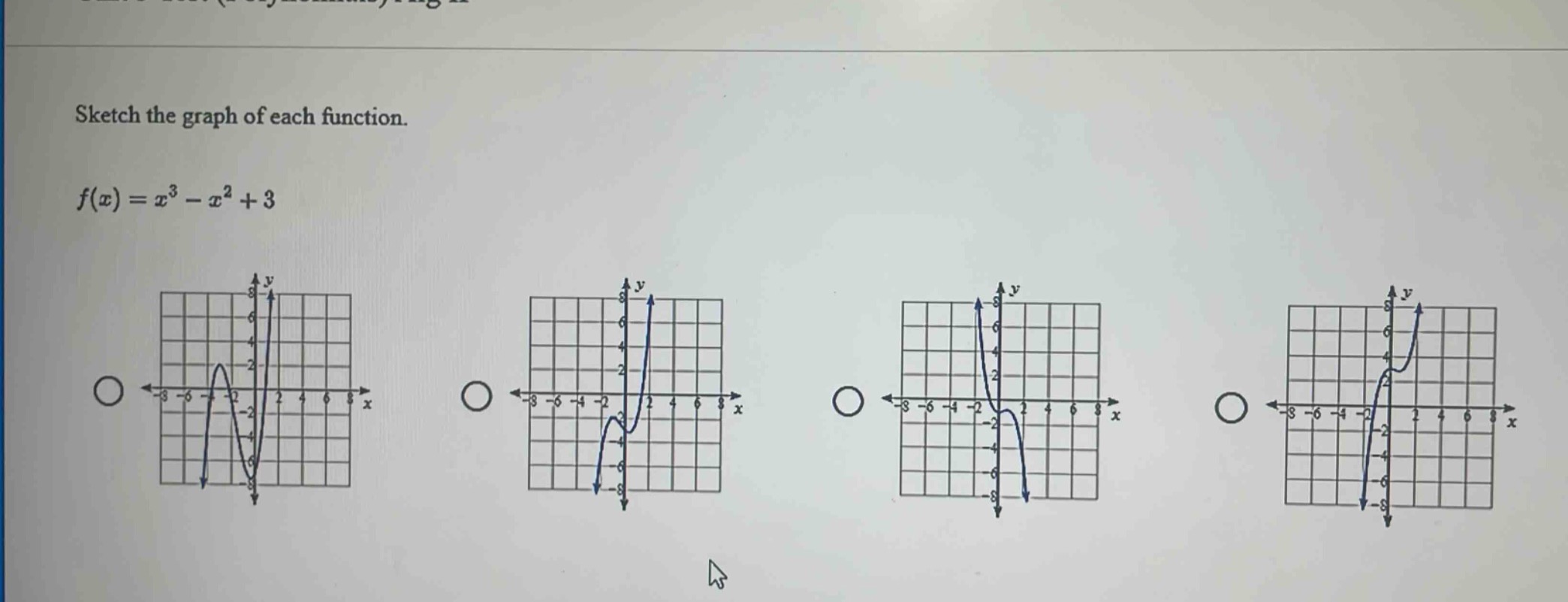
sketch the graph of each function.\nf(x)=x^{3}-x^{2}+3
Answer
Answer:
The graph of (y = x^{3}-x^{2}+3) has the following characteristics:
- Y - intercept:
- Set (x = 0) in the function (y=f(x)=x^{3}-x^{2}+3). Then (y=0^{3}-0^{2}+3 = 3). So the graph intersects the (y) - axis at the point ((0,3)).
- First - derivative:
- Differentiate (y=x^{3}-x^{2}+3) using the power rule ((x^{n})^\prime=nx^{n - 1}). The derivative (y^\prime=f^\prime(x)=3x^{2}-2x=x(3x - 2)).
- Set (y^\prime = 0) to find the critical points. So (x(3x - 2)=0), which gives (x = 0) and (x=\frac{2}{3}).
- Second - derivative:
- Differentiate (y^\prime=3x^{2}-2x) to get the second - derivative (y^{\prime\prime}=f^{\prime\prime}(x)=6x-2).
- Evaluate the second - derivative at the critical points:
- When (x = 0), (y^{\prime\prime}(0)=6\times0 - 2=-2\lt0), so the function has a local maximum at (x = 0). And (y(0)=3).
- When (x=\frac{2}{3}), (y^{\prime\prime}(\frac{2}{3})=6\times\frac{2}{3}-2=4 - 2 = 2\gt0), so the function has a local minimum at (x=\frac{2}{3}). And (y(\frac{2}{3})=(\frac{2}{3})^{3}-(\frac{2}{3})^{2}+3=\frac{8}{27}-\frac{4}{9}+3=\frac{8 - 12}{27}+3=3-\frac{4}{27}=\frac{81 - 4}{27}=\frac{77}{27}\approx2.85).
- End - behavior:
- Since the leading term of the polynomial (y=x^{3}-x^{2}+3) is (x^{3}) and the coefficient of (x^{3}) is positive ((a = 1\gt0)), as (x\to-\infty), (y\to-\infty) and as (x\to+\infty), (y\to+\infty).
Based on the above - mentioned properties, we can sketch the graph. The correct graph is the one that has a (y) - intercept at ((0,3)), a local maximum at ((0,3)) and a local minimum at ((\frac{2}{3},\frac{77}{27})) and has the correct end - behavior.
Explanation:
Step1: Find y - intercept
Set (x = 0) in (y=x^{3}-x^{2}+3), (y=3).
Step2: Find critical points
Differentiate (y=x^{3}-x^{2}+3) to get (y^\prime=3x^{2}-2x=x(3x - 2)). Set (y^\prime = 0), (x = 0) or (x=\frac{2}{3}).
Step3: Classify critical points
Differentiate (y^\prime) to get (y^{\prime\prime}=6x - 2). Evaluate at critical points: (y^{\prime\prime}(0)=-2), (y^{\prime\prime}(\frac{2}{3})=2).
Step4: Determine end - behavior
Since leading term is (x^{3}) with positive coefficient, as (x\to-\infty,y\to-\infty) and as (x\to+\infty,y\to+\infty).