sketch the graph of the function. $y = \\cos(\\frac{x}{2})+1$
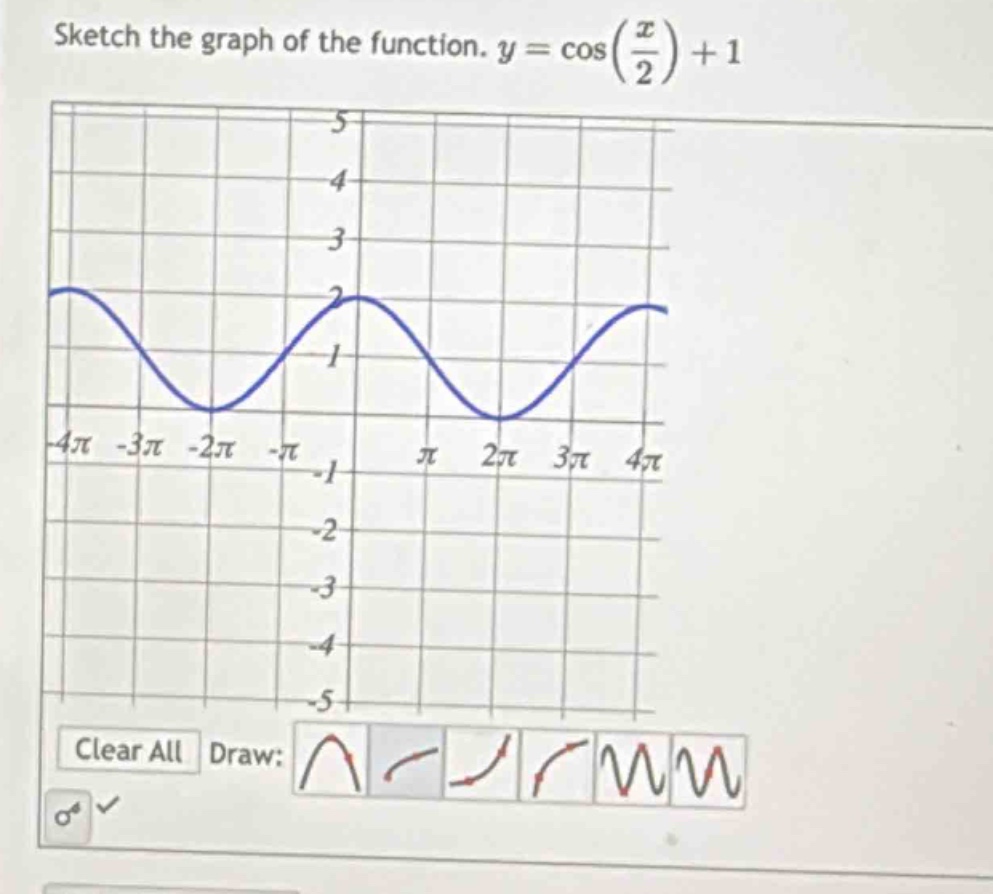
sketch the graph of the function. $y = \\cos(\\frac{x}{2})+1$
Answer
Explanation:
Step1: Identify the standard cosine - function properties
The general form of a cosine function is $y = A\cos(Bx - C)+D$. For the function $y=\cos(\frac{x}{2}) + 1$, we have $A = 1$, $B=\frac{1}{2}$, $C = 0$, and $D = 1$.
Step2: Calculate the period
The period of a cosine function $y = A\cos(Bx - C)+D$ is given by $T=\frac{2\pi}{|B|}$. Since $B=\frac{1}{2}$, then $T=\frac{2\pi}{\frac{1}{2}}=4\pi$.
Step3: Determine the amplitude
The amplitude of the function $y = A\cos(Bx - C)+D$ is $|A|$. Here, $|A| = 1$.
Step4: Find the vertical shift
The vertical - shift of the function is given by $D$. Here, $D = 1$, which means the graph of $y=\cos(\frac{x}{2})$ is shifted 1 unit up.
Step5: Find key points
For the standard cosine function $y=\cos(x)$, key points are $(0,1),(\frac{\pi}{2},0),(\pi,- 1),(\frac{3\pi}{2},0),(2\pi,1)$. For $y=\cos(\frac{x}{2})+1$, when $x = 0$, $y=\cos(0)+1=2$; when $x = 2\pi$, $y=\cos(\pi)+1=0$; when $x = 4\pi$, $y=\cos(2\pi)+1=2$.
The graph is a cosine - wave with period $4\pi$, amplitude 1, and shifted 1 unit up.
Answer:
The graph is a cosine - type wave with period $4\pi$, amplitude 1, and vertically shifted 1 unit up. It oscillates between $y = 0$ and $y = 2$ with key points at $(0,2),(2\pi,0),(4\pi,2)$ etc.