sketch the graph of the function f to determine the type of discontinuity at each x - value.\nf(x)=\begin{cas…
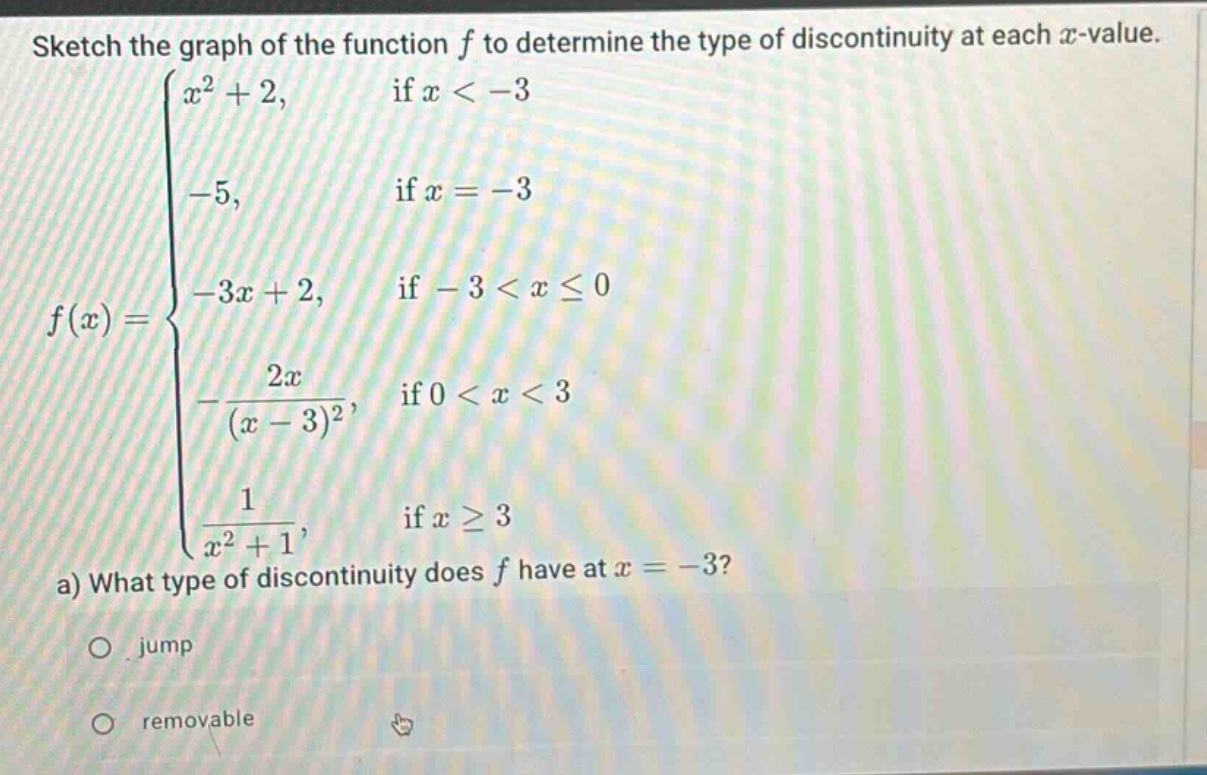
sketch the graph of the function f to determine the type of discontinuity at each x - value.\nf(x)=\begin{cases}x^{2}+2, & \text{if }x < - 3\\-5, & \text{if }x=-3\\-3x + 2, & \text{if }-3 < xleq0\\-\frac{2x}{(x - 3)^{2}}, & \text{if }0 < x < 3\\\frac{1}{x^{2}+1}, & \text{if }xgeq3end{cases}\na) what type of discontinuity does f have at x=-3?\no jump\no removable
Answer
Explanation:
Step1: Calculate left - hand limit
We find $\lim_{x\rightarrow - 3^{-}}f(x)$. Since $x\rightarrow - 3^{-}$ means $x < - 3$, we use $f(x)=x^{2}+2$. Then $\lim_{x\rightarrow - 3^{-}}f(x)=\lim_{x\rightarrow - 3^{-}}(x^{2}+2)=(-3)^{2}+2=9 + 2=11$.
Step2: Calculate right - hand limit
For $x\rightarrow - 3^{+}$, we have $-3<x\leq0$, so $f(x)=-3x + 2$. Then $\lim_{x\rightarrow - 3^{+}}f(x)=\lim_{x\rightarrow - 3^{+}}(-3x + 2)=-3\times(-3)+2=9 + 2=11$.
Step3: Evaluate function at the point
We know $f(-3)=-5$.
Step4: Determine discontinuity type
Since $\lim_{x\rightarrow - 3^{-}}f(x)=\lim_{x\rightarrow - 3^{+}}f(x)=11$ but $f(-3)=-5$, the limit exists but is not equal to the function value at $x = - 3$. This is a removable discontinuity.
Answer:
removable