6. a. sketch a graph of the function f given by f(θ)=3cos(θ + π). 4 pts. b. how does the graph of f compare…
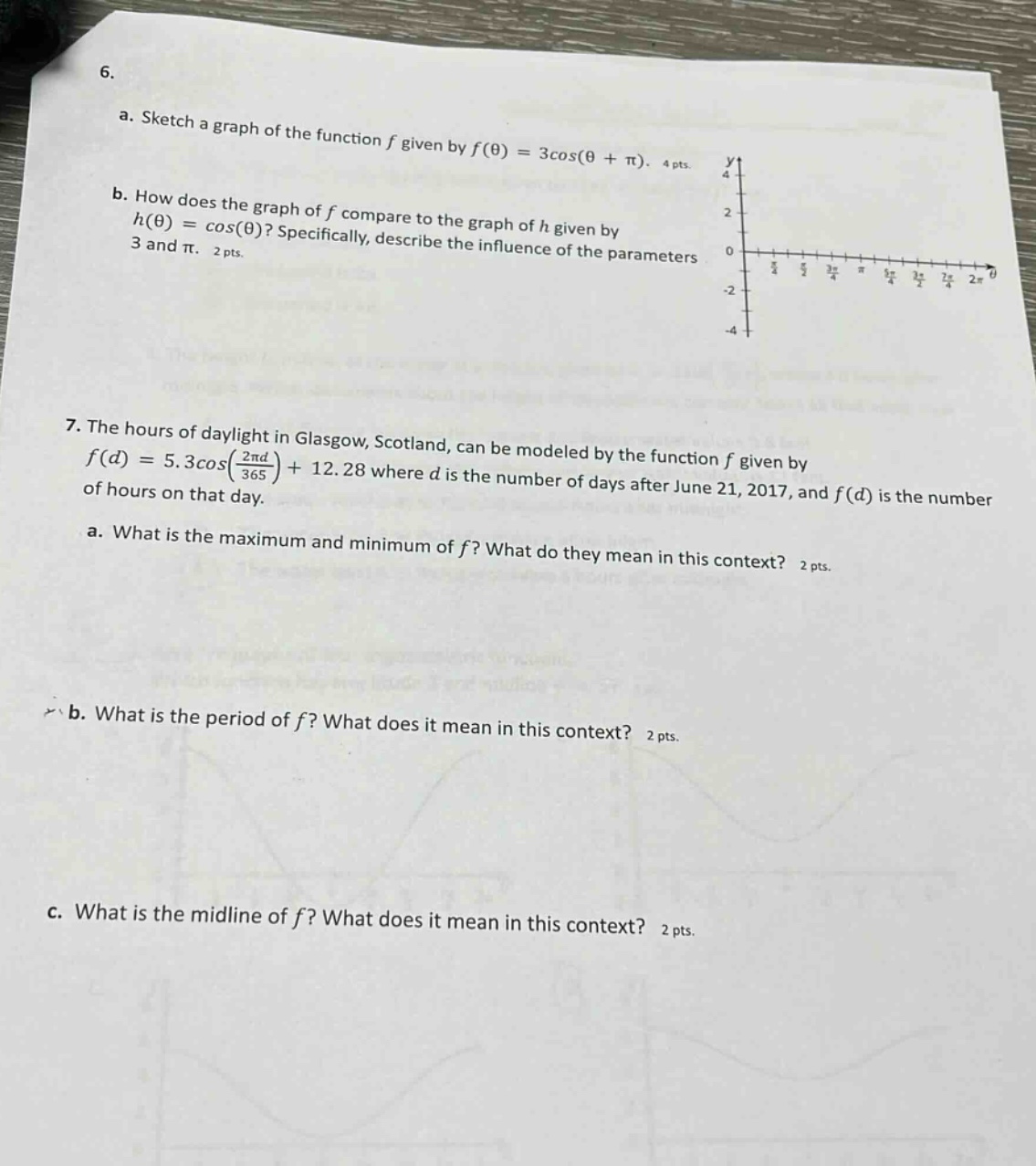
6. a. sketch a graph of the function f given by f(θ)=3cos(θ + π). 4 pts. b. how does the graph of f compare to the graph of h given by h(θ)=cos(θ)? specifically, describe the influence of the parameters 3 and π. 2 pts. 7. the hours of daylight in glasgow, scotland, can be modeled by the function f given by f(d)=5.3cos(\\frac{2\\pi d}{365}) + 12.28 where d is the number of days after june 21, 2017, and f(d) is the number of hours on that day. a. what is the maximum and minimum of f? what do they mean in this context? 2 pts. b. what is the period of f? what does it mean in this context? 2 pts. c. what is the mid - line of f? what does it mean in this context? 2 pts.
Answer
6a.
Explanation:
Step1: Recall cosine - function properties
The general form of a cosine function is $y = A\cos(B\theta - C)+D$. For $f(\theta)=3\cos(\theta+\pi)$, $A = 3$, $B = 1$, $C=-\pi$, $D = 0$. The amplitude of $y = A\cos(B\theta - C)+D$ is $|A|$, so the amplitude of $f(\theta)$ is $|3| = 3$. The period of $y=\cos(B\theta)$ is $T=\frac{2\pi}{|B|}$, so the period of $f(\theta)$ is $\frac{2\pi}{|1|}=2\pi$. We know that $\cos(\theta+\pi)=-\cos(\theta)$. When $\theta = 0$, $f(0)=3\cos(\pi)=- 3$; when $\theta=\frac{\pi}{2}$, $f(\frac{\pi}{2})=3\cos(\frac{\pi}{2}+\pi)=0$; when $\theta=\pi$, $f(\pi)=3\cos(2\pi)=3$; when $\theta=\frac{3\pi}{2}$, $f(\frac{3\pi}{2})=3\cos(\frac{3\pi}{2}+\pi)=0$; when $\theta = 2\pi$, $f(2\pi)=3\cos(3\pi)=-3$. Then we can sketch the graph of $y = 3\cos(\theta+\pi)$ which is a cosine - wave with amplitude 3, period $2\pi$, and reflected about the $x$ - axis compared to $y = \cos(\theta)$.
6b.
Explanation:
Step1: Analyze the effect of the parameter 3
The parameter $A = 3$ in $y = A\cos(\theta)$ is the amplitude. For $h(\theta)=\cos(\theta)$ with amplitude 1 and $f(\theta)=3\cos(\theta+\pi)$, the graph of $f$ has an amplitude 3 times that of $h$. The values of $f(\theta)$ range from - 3 to 3, while the values of $h(\theta)$ range from - 1 to 1.
Step2: Analyze the effect of the parameter $\pi$
The parameter $\pi$ in $f(\theta)=3\cos(\theta+\pi)$ is a phase - shift. The general form of a phase - shift for $y=\cos(\theta)$ is $y=\cos(\theta - C)$. Here $C =-\pi$, which means the graph of $y = 3\cos(\theta)$ is shifted $\pi$ units to the left. Also, $\cos(\theta+\pi)=-\cos(\theta)$, so the graph of $f(\theta)$ is a reflection of $y = 3\cos(\theta)$ (and also of $h(\theta)=\cos(\theta)$) about the $x$ - axis.
7a.
Explanation:
Step1: Recall the range of the cosine function
The function is $f(d)=5.3\cos(\frac{2\pi d}{365})+12.28$. The range of the cosine function $y = \cos(x)$ is $[-1,1]$.
Step2: Find the maximum value
When $\cos(\frac{2\pi d}{365}) = 1$, $f(d)_{max}=5.3\times1 + 12.28=17.58$. In the context of the hours of daylight, this represents the maximum number of hours of daylight in Glasgow after June 21, 2017.
Step3: Find the minimum value
When $\cos(\frac{2\pi d}{365})=-1$, $f(d)_{min}=5.3\times(-1)+12.28 = 6.98$. In the context of the hours of daylight, this represents the minimum number of hours of daylight in Glasgow after June 21, 2017.
Answer:
Maximum: 17.58 hours, represents the most hours of daylight; Minimum: 6.98 hours, represents the least hours of daylight.
7b.
Explanation:
Step1: Recall the period formula for a cosine function
The general form of a cosine function is $y = A\cos(Bx - C)+D$, and its period is $T=\frac{2\pi}{|B|}$. For the function $f(d)=5.3\cos(\frac{2\pi d}{365})+12.28$, $B=\frac{2\pi}{365}$.
Step2: Calculate the period
Using the formula $T=\frac{2\pi}{|B|}$, we substitute $B=\frac{2\pi}{365}$ into it: $T=\frac{2\pi}{\frac{2\pi}{365}}=365$ days. In the context of the hours of daylight, this means that the pattern of the number of hours of daylight in Glasgow repeats every 365 days (a year).
Answer:
Period: 365 days, represents the time - interval for the daylight - hour pattern to repeat.
7c.
Explanation:
Step1: Recall the mid - line formula for a cosine function
For a cosine function of the form $y = A\cos(Bx - C)+D$, the mid - line is given by $y = D$. For the function $f(d)=5.3\cos(\frac{2\pi d}{365})+12.28$, $D = 12.28$. In the context of the hours of daylight, the mid - line $y = 12.28$ represents the average number of hours of daylight in Glasgow over the course of a year.
Answer:
Mid - line: $y = 12.28$, represents the average number of hours of daylight per day over a year.