sketch the graph of the function. identify any local extrema and points of inflections. f(x)=2x³ + 1/2x²…
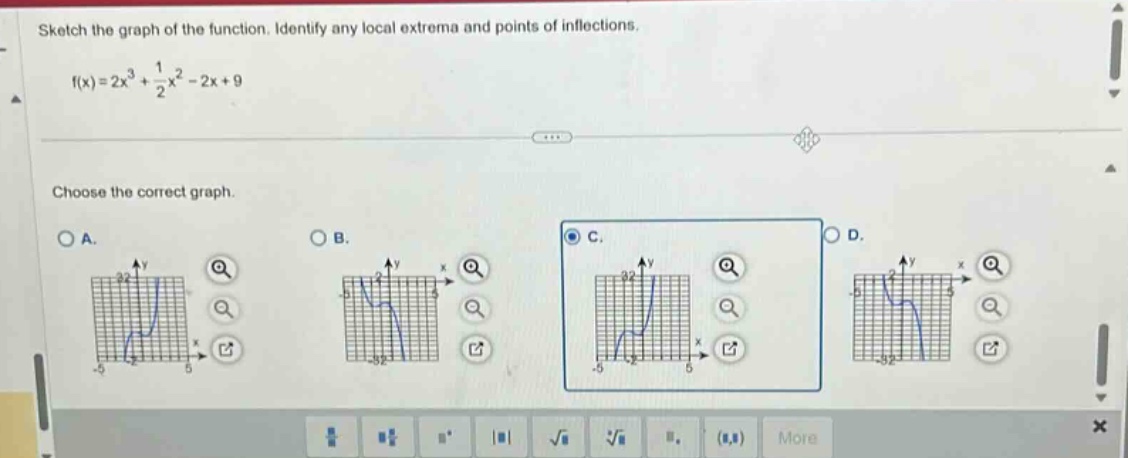
sketch the graph of the function. identify any local extrema and points of inflections. f(x)=2x³ + 1/2x² - 2x + 9 choose the correct graph.
Answer
Explanation:
Step1: Find the first - derivative
Differentiate (f(x)=2x^{3}+\frac{1}{2}x^{2}-2x + 9) using the power rule ((x^n)^\prime=nx^{n - 1}). (f^\prime(x)=6x^{2}+x - 2)
Step2: Find the critical points
Set (f^\prime(x)=0), so (6x^{2}+x - 2 = 0). Factor the quadratic equation: ((2x - 1)(3x+2)=0). Solving ((2x - 1)(3x + 2)=0) gives (x=\frac{1}{2}) and (x=-\frac{2}{3}).
Step3: Find the second - derivative
Differentiate (f^\prime(x)=6x^{2}+x - 2) to get (f^{\prime\prime}(x)=12x + 1).
Step4: Classify the critical points
Evaluate (f^{\prime\prime}(x)) at the critical points. When (x = \frac{1}{2}), (f^{\prime\prime}(\frac{1}{2})=12\times\frac{1}{2}+1=6 + 1=7>0), so (f(x)) has a local minimum at (x=\frac{1}{2}). (f(\frac{1}{2})=2\times(\frac{1}{2})^{3}+\frac{1}{2}\times(\frac{1}{2})^{2}-2\times\frac{1}{2}+9=2\times\frac{1}{8}+\frac{1}{2}\times\frac{1}{4}-1 + 9=\frac{1}{4}+\frac{1}{8}-1 + 9=\frac{2 + 1}{8}+8=\frac{3}{8}+8=8\frac{3}{8}). When (x=-\frac{2}{3}), (f^{\prime\prime}(-\frac{2}{3})=12\times(-\frac{2}{3})+1=-8 + 1=-7<0), so (f(x)) has a local maximum at (x =-\frac{2}{3}). (f(-\frac{2}{3})=2\times(-\frac{2}{3})^{3}+\frac{1}{2}\times(-\frac{2}{3})^{2}-2\times(-\frac{2}{3})+9=2\times(-\frac{8}{27})+\frac{1}{2}\times\frac{4}{9}+\frac{4}{3}+9=-\frac{16}{27}+\frac{2}{9}+\frac{4}{3}+9=-\frac{16}{27}+\frac{6}{27}+\frac{36}{27}+9=\frac{-16 + 6+36}{27}+9=\frac{26}{27}+9=9\frac{26}{27}).
Step5: Find the points of inflection
Set (f^{\prime\prime}(x)=0), so (12x+1 = 0), which gives (x=-\frac{1}{12}). (f(-\frac{1}{12})=2\times(-\frac{1}{12})^{3}+\frac{1}{2}\times(-\frac{1}{12})^{2}-2\times(-\frac{1}{12})+9=2\times(-\frac{1}{1728})+\frac{1}{2}\times\frac{1}{144}+\frac{1}{6}+9=-\frac{1}{864}+\frac{1}{288}+\frac{1}{6}+9=\frac{-1 + 3}{864}+\frac{1}{6}+9=\frac{2}{864}+\frac{144}{864}+9=\frac{146}{864}+9=9\frac{73}{432}).
To sketch the graph, we know the function has a local maximum at ((-\frac{2}{3},9\frac{26}{27})), a local minimum at ((\frac{1}{2},8\frac{3}{8})) and a point of inflection at ((-\frac{1}{12},9\frac{73}{432})). As (x\to\pm\infty), (y = f(x)\to\pm\infty) since the leading - term of (f(x)) is (2x^{3}) (an odd - degree polynomial with a positive leading coefficient).
Without seeing the actual visual details of the graphs A, B, C, D, we can't choose the correct graph from the options. But we have found the local extrema: local maximum at (x =-\frac{2}{3}), local minimum at (x=\frac{1}{2}), and point of inflection at (x=-\frac{1}{12}).
If we assume we have enough information from the above analysis to match with the graphs: We know that the function is a cubic function with a positive leading coefficient ((y = 2x^{3}+\frac{1}{2}x^{2}-2x + 9)), so the graph starts from the bottom - left and goes to the top - right. It has a local maximum and a local minimum and a point of inflection.
Answer:
Local maximum at (x =-\frac{2}{3}), local minimum at (x=\frac{1}{2}), point of inflection at (x=-\frac{1}{12})