sketch the graph of the rational function by hand. as sketching aids, check for intercepts, vertical…
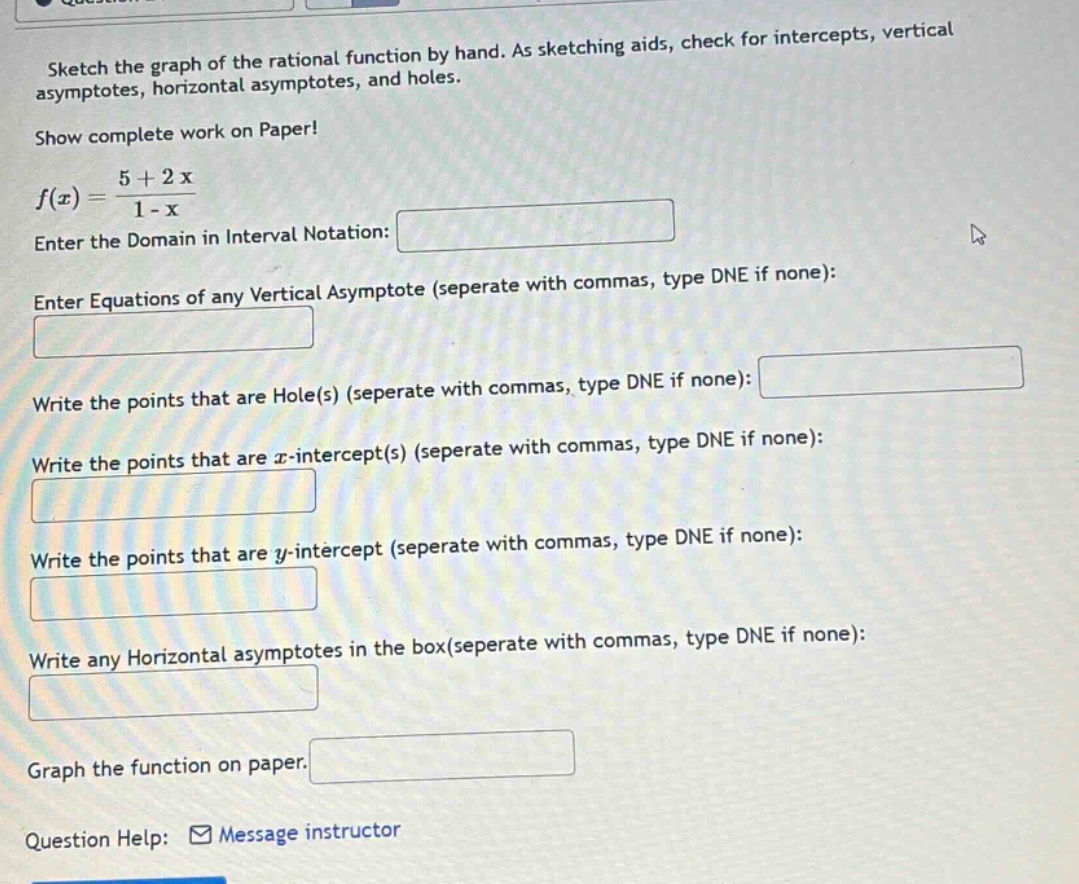
sketch the graph of the rational function by hand. as sketching aids, check for intercepts, vertical asymptotes, horizontal asymptotes, and holes. show complete work on paper! $f(x)=\frac{5 + 2x}{1 - x}$ enter the domain in interval notation: enter equations of any vertical asymptote (seperate with commas, type dne if none): write the points that are hole(s) (seperate with commas, type dne if none): write the points that are $x$-intercept(s) (seperate with commas, type dne if none): write the points that are $y$-intercept (seperate with commas, type dne if none): write any horizontal asymptotes in the box(seperate with commas, type dne if none): graph the function on paper. question help: message instructor
Answer
Answer:
- Domain: $(-\infty,1)\cup(1,\infty)$
- Vertical Asymptote: $x = 1$
- Holes: DNE
- $x$-intercept: $\left(-\frac{5}{2},0\right)$
- $y$-intercept: $(0,5)$
- Horizontal Asymptote: $y=-2$
Explanation:
Step1: Find the domain
Set the denominator $1 - x=0$, solve for $x$ gives $x = 1$. Domain is all real - numbers except $x = 1$, written as $(-\infty,1)\cup(1,\infty)$.
Step2: Find vertical asymptote
Vertical asymptote occurs at the value of $x$ that makes the denominator zero. Since $1 - x = 0$ when $x = 1$, the vertical asymptote is $x = 1$.
Step3: Check for holes
Since the numerator $5 + 2x$ and denominator $1 - x$ have no common factors, there are no holes.
Step4: Find $x$-intercept
Set $y=f(x)=0$, so $\frac{5 + 2x}{1 - x}=0$. This implies $5+2x = 0$ (since a fraction is zero when the numerator is zero and denominator is non - zero). Solving $5+2x = 0$ gives $x=-\frac{5}{2}$, so the $x$-intercept is $\left(-\frac{5}{2},0\right)$.
Step5: Find $y$-intercept
Set $x = 0$. Then $f(0)=\frac{5+2\times0}{1 - 0}=5$, so the $y$-intercept is $(0,5)$.
Step6: Find horizontal asymptote
Since the degree of the numerator and denominator are the same (both degree 1), the horizontal asymptote is $y=\frac{a}{b}$, where $a$ is the leading coefficient of the numerator and $b$ is the leading coefficient of the denominator. Here $a = 2$ and $b=-1$, so $y=-2$.