sketch the graph and show all local extrema and inflection points.\ny = x + sin x, 0 ≤ x ≤ 2π
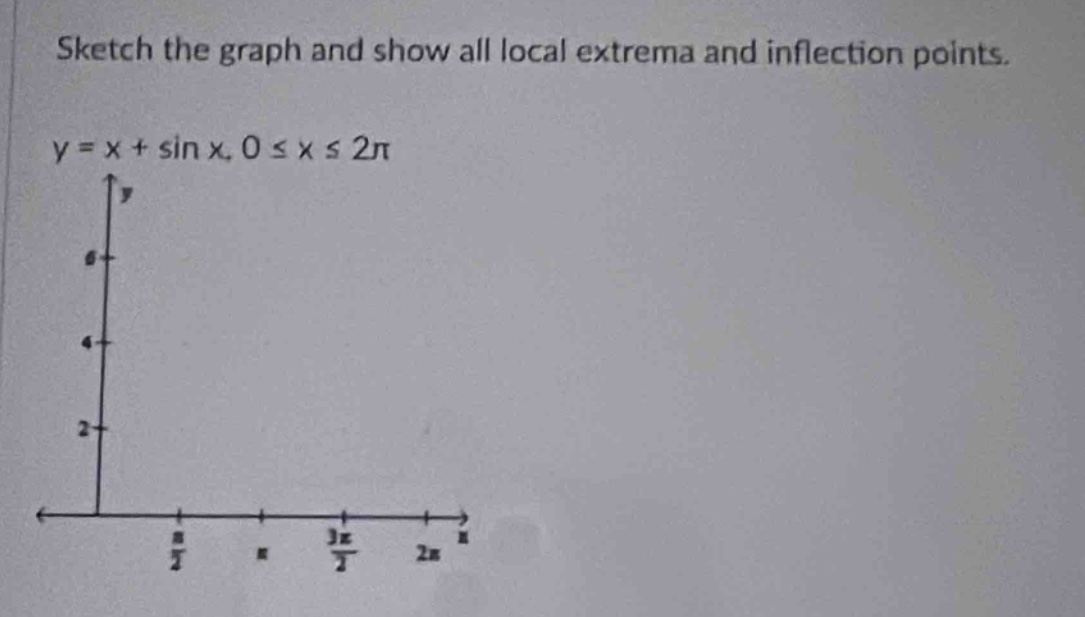
sketch the graph and show all local extrema and inflection points.\ny = x + sin x, 0 ≤ x ≤ 2π
Answer
Explanation:
Step1: Find the first - derivative
Differentiate $y = x+\sin x$ using sum - rule and derivative of $\sin x$. The derivative of $x$ is $1$ and the derivative of $\sin x$ is $\cos x$. So, $y'=1 + \cos x$.
Step2: Find local extrema
Set $y' = 0$. Then $1+\cos x=0$, so $\cos x=-1$. In the interval $0\leq x\leq2\pi$, $x = \pi$. To determine if it's a local extremum, we can use the first - derivative test. For $0\leq x<\pi$, $\cos x>- 1$, so $y'>0$. For $\pi<x\leq2\pi$, $\cos x>-1$, so $y'>0$. Since the function is increasing on both sides of $x = \pi$, there are no local extrema.
Step3: Find the second - derivative
Differentiate $y'=1+\cos x$. The derivative of $1$ is $0$ and the derivative of $\cos x$ is $-\sin x$. So, $y''=-\sin x$.
Step4: Find inflection points
Set $y'' = 0$. Then $-\sin x=0$. In the interval $0\leq x\leq2\pi$, $x = 0,\pi,2\pi$.
Answer:
No local extrema. Inflection points are $(0,0),(\pi,\pi),(2\pi,2\pi)$