sketch a non - constant function that is continuous on (-oo,oo) and has the following properties. use a…
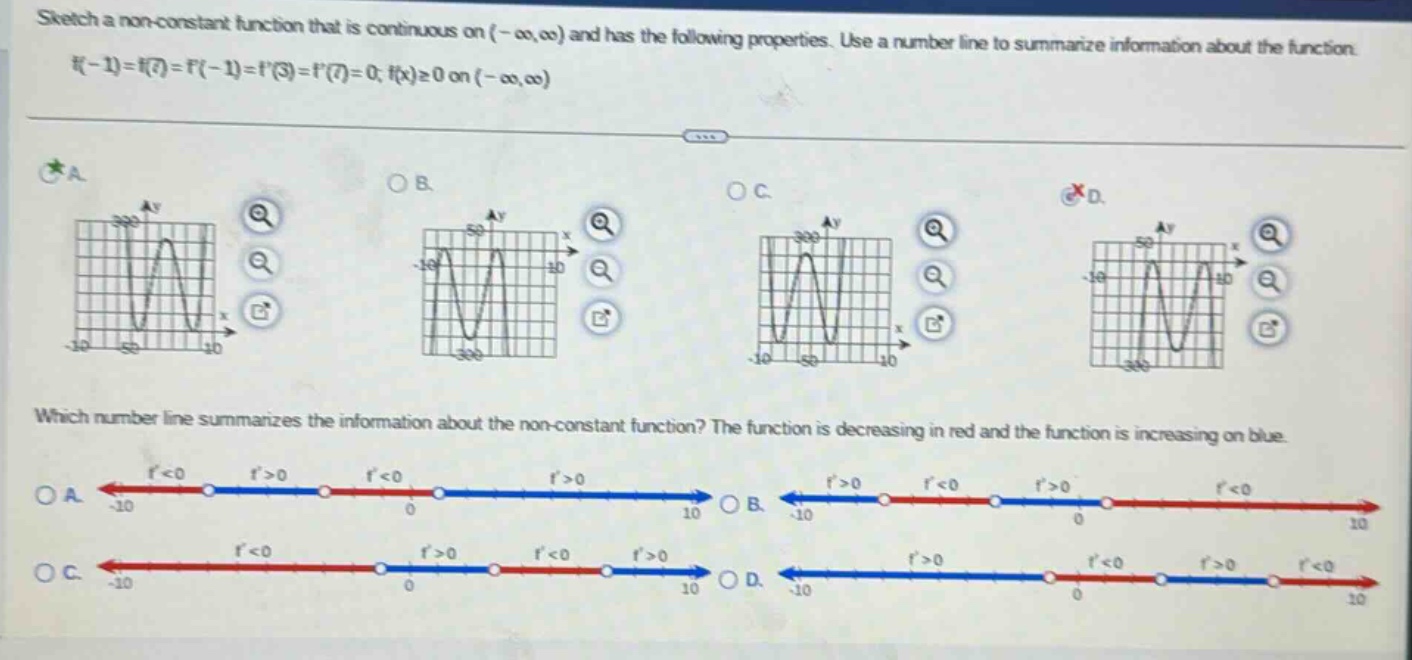
sketch a non - constant function that is continuous on (-oo,oo) and has the following properties. use a number line to summarize information about the function. f(-1)=f(7)=f(-1)=f(3)=f(7)=0; f(x)>=0 on (-oo,oo) which number line summarizes the information about the non - constant function? the function is decreasing in red and the function is increasing on blue.
Answer
Explanation:
Step1: Analyze critical - points
Given (f(-1)=f(7)) and (f'(-1)=f'(3)=f'(7) = 0), these points (-1), (3), and (7) are critical points where the slope of the function is zero.
Step2: Analyze sign of derivative for increasing - decreasing
Since (f(x)\geq0) on ((-\infty,\infty)), we know the function lies on or above the (x) - axis. A function (y = f(x)) is increasing when (f'(x)>0) and decreasing when (f'(x)<0). Starting from the left - hand side of the number line, as we move from (-\infty) to (-1), assume the function is increasing so (f'(x)>0). At (x=-1), (f'(-1) = 0). Then from (x=-1) to (x = 3), the function is decreasing so (f'(x)<0). At (x = 3), (f'(3)=0). From (x = 3) to (x=7), the function is increasing so (f'(x)>0). At (x = 7), (f'(7)=0). And from (x = 7) to (\infty), the function is decreasing so (f'(x)<0).
Answer:
B.