sketching graphs a) intercepts: find x and b) asymptotes: find any vertical c) derivatives and domain d)…
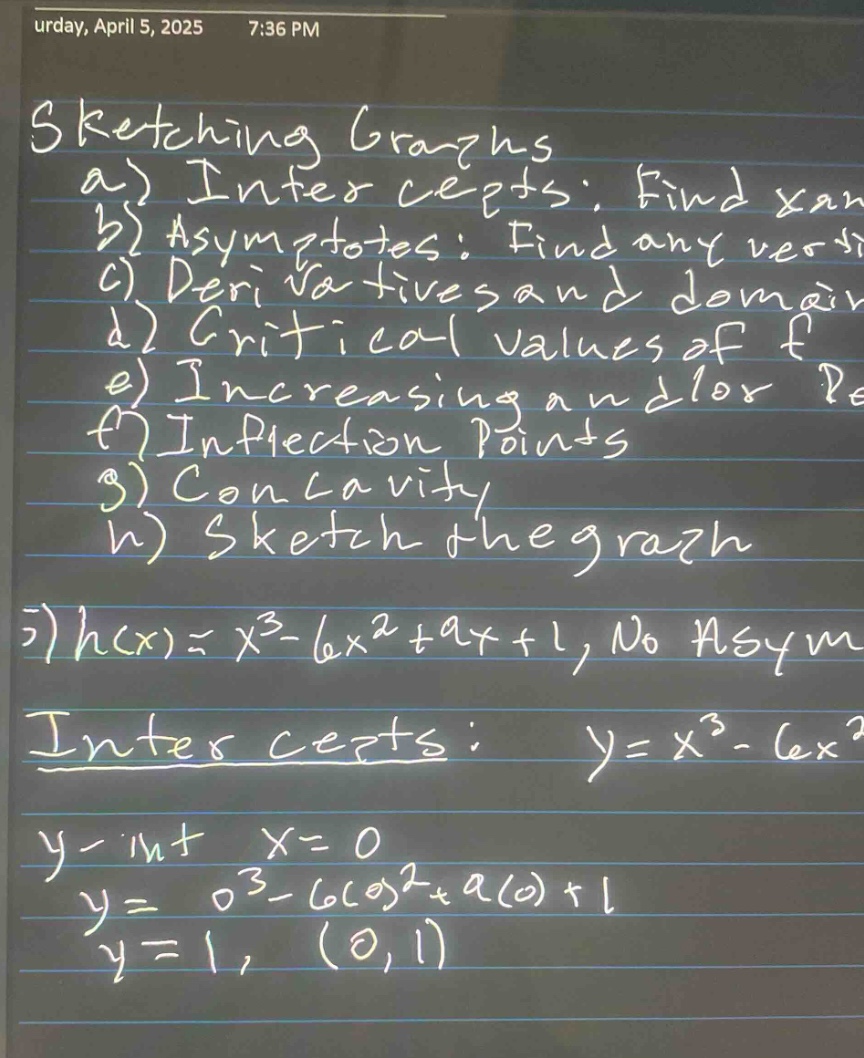
sketching graphs a) intercepts: find x and b) asymptotes: find any vertical c) derivatives and domain d) critical values of f e) increasing and/or decreasing f) inflection points g) concavity h) sketch the graph 5) h(x)=x³ - 6x²+9x + 1, no asym intercepts: y = x³ - 6x² y - int x = 0 y = 0³ - 6(0)²+9(0)+1 y = 1, (0,1)
Answer
Explanation:
Step1: Find y - intercept
Set (x = 0) in (h(x)=x^{3}-6x^{2}+9x + 1). [y=0^{3}-6\times0^{2}+9\times0 + 1=1] So the y - intercept is the point ((0,1)).
Step2: Find x - intercepts
Set (y = 0), so (x^{3}-6x^{2}+9x + 1=0). This is a cubic equation. We can try some simple values of (x) like (x=-1): ((-1)^{3}-6\times(-1)^{2}+9\times(-1)+1=-1 - 6-9 + 1=-15), (x = 1): (1^{3}-6\times1^{2}+9\times1+1=1-6 + 9+1=5), (x=5): (5^{3}-6\times5^{2}+9\times5+1=125-150 + 45+1=21), (x = 6): (6^{3}-6\times6^{2}+9\times6+1=0 + 54+1=55). By using a numerical method (such as Newton - Raphson method) or a graphing utility, we can find the real roots of the cubic equation. But for the purpose of graph - sketching, we know the y - intercept.
Step3: Find the derivative
Differentiate (h(x)=x^{3}-6x^{2}+9x + 1) using the power rule ((x^{n})^\prime=nx^{n - 1}). [h^\prime(x)=3x^{2}-12x + 9=3(x^{2}-4x + 3)=3(x - 1)(x - 3)]
Step4: Find critical values
Set (h^\prime(x)=0). [3(x - 1)(x - 3)=0] So (x = 1) and (x = 3) are the critical values.
Step5: Determine increasing and decreasing intervals
Test the intervals ((-\infty,1)), ((1,3)) and ((3,\infty)) using test points. For the interval ((-\infty,1)), let (x = 0), then (h^\prime(0)=3\times(0 - 1)\times(0 - 3)=9>0), so (h(x)) is increasing on ((-\infty,1)). For the interval ((1,3)), let (x = 2), then (h^\prime(2)=3\times(2 - 1)\times(2 - 3)=-3<0), so (h(x)) is decreasing on ((1,3)). For the interval ((3,\infty)), let (x = 4), then (h^\prime(4)=3\times(4 - 1)\times(4 - 3)=9>0), so (h(x)) is increasing on ((3,\infty)).
Step6: Find the second - derivative
Differentiate (h^\prime(x)=3x^{2}-12x + 9) to get (h^{\prime\prime}(x)=6x-12).
Step7: Find inflection points
Set (h^{\prime\prime}(x)=0). [6x-12=0\Rightarrow x = 2] When (x = 2), (h(2)=2^{3}-6\times2^{2}+9\times2+1=8-24 + 18+1=3). So the inflection point is ((2,3)).
Step8: Determine concavity
Test the intervals ((-\infty,2)) and ((2,\infty)) using test points. For the interval ((-\infty,2)), let (x = 1), then (h^{\prime\prime}(1)=6\times1-12=-6<0), so (h(x)) is concave down on ((-\infty,2)). For the interval ((2,\infty)), let (x = 3), then (h^{\prime\prime}(3)=6\times3-12 = 6>0), so (h(x)) is concave up on ((2,\infty)).
Answer:
The y - intercept is ((0,1)). Critical values are (x = 1) and (x = 3). The function is increasing on ((-\infty,1)\cup(3,\infty)) and decreasing on ((1,3)). The inflection point is ((2,3)), concave down on ((-\infty,2)) and concave up on ((2,\infty)).