a small lake is stocked with a certain species of fish. the fish population is modeled by the function p =…
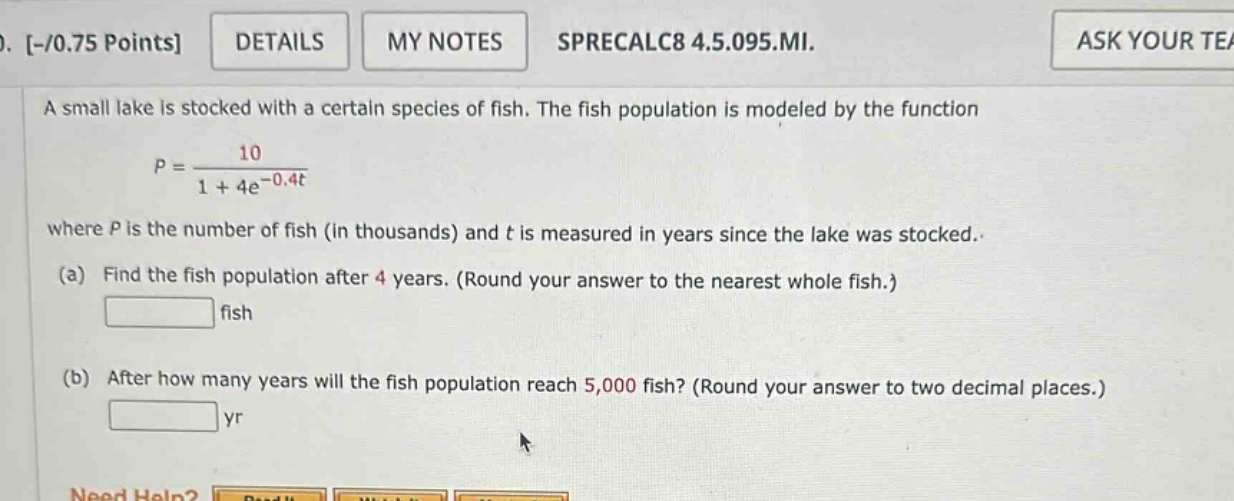
a small lake is stocked with a certain species of fish. the fish population is modeled by the function p = 10 / (1 + 4e^(-0.4t)) where p is the number of fish (in thousands) and t is measured in years since the lake was stocked. (a) find the fish population after 4 years. (round your answer to the nearest whole fish.) fish (b) after how many years will the fish population reach 5,000 fish? (round your answer to two decimal places.) yr
Answer
Explanation:
Step1: Substitute $t = 4$ into the formula
We have $P=\frac{10}{1 + 4e^{-0.4\times4}}$. First, calculate the exponent: $-0.4\times4=-1.6$. Then find $e^{-1.6}\approx0.2019$. Next, $4e^{-1.6}\approx4\times0.2019 = 0.8076$. And $1+4e^{-1.6}\approx1 + 0.8076=1.8076$. So $P=\frac{10}{1.8076}\approx5.531$. Since $P$ is in thousands, the number of fish is $5.531\times1000 = 5531$.
Step2: Set $P = 5$ (since $P$ is in thousands) and solve for $t$
Set $\frac{10}{1 + 4e^{-0.4t}}=5$. Cross - multiply to get $10 = 5(1 + 4e^{-0.4t})$. Then $10=5 + 20e^{-0.4t}$. Subtract 5 from both sides: $5=20e^{-0.4t}$. Divide both sides by 20: $e^{-0.4t}=\frac{5}{20}=0.25$. Take the natural logarithm of both sides: $\ln(e^{-0.4t})=\ln(0.25)$. Using the property $\ln(e^{x})=x$, we have $-0.4t=\ln(0.25)$. Since $\ln(0.25)\approx - 1.3863$, then $t=\frac{\ln(0.25)}{-0.4}=\frac{-1.3863}{-0.4}\approx3.47$.
Answer:
(a) 5531 fish (b) 3.47 yr