solve for $f(x)$ if $f(x)=cot x\tan x$ \na. $f(x)=cos(x)csc(x)+sec(x)sin(x)$ \nb. $f(x)=cot(x)sec^{2}(x)-\tan…
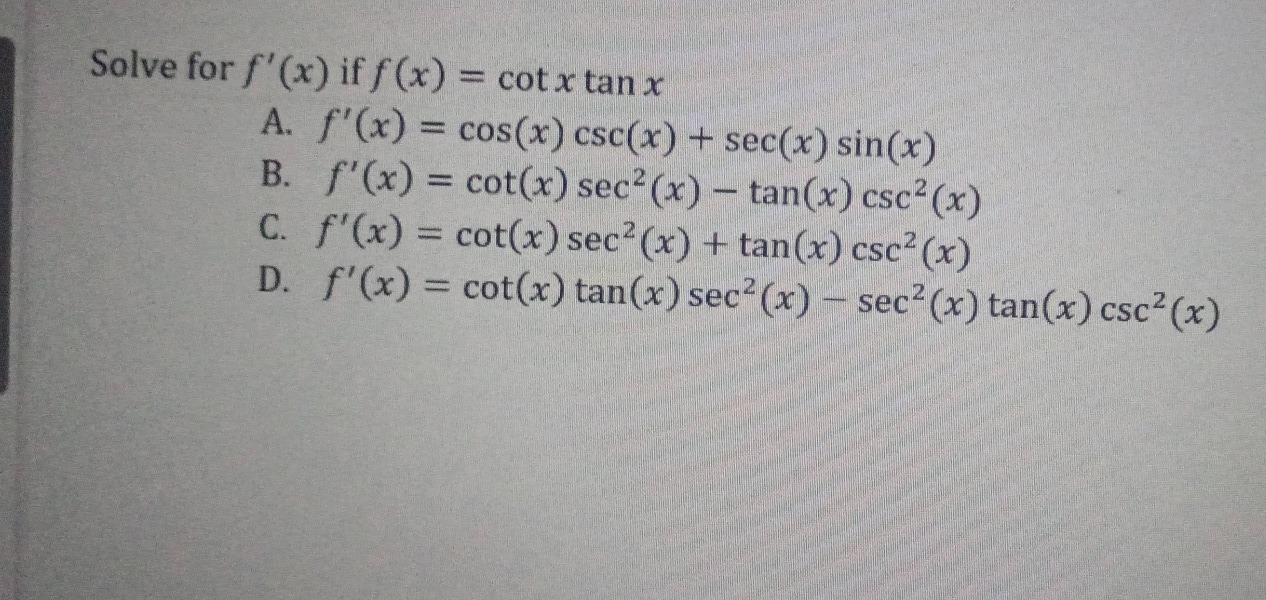
solve for $f(x)$ if $f(x)=cot x\tan x$ \na. $f(x)=cos(x)csc(x)+sec(x)sin(x)$ \nb. $f(x)=cot(x)sec^{2}(x)-\tan(x)csc^{2}(x)$ \nc. $f(x)=cot(x)sec^{2}(x)+\tan(x)csc^{2}(x)$ \nd. $f(x)=cot(x)\tan(x)sec^{2}(x)-sec^{2}(x)\tan(x)csc^{2}(x)$
Answer
Explanation:
Step1: Simplify the function
Since $\cot x=\frac{\cos x}{\sin x}$ and $\tan x = \frac{\sin x}{\cos x}$, then $f(x)=\cot x\tan x=\frac{\cos x}{\sin x}\cdot\frac{\sin x}{\cos x}=1$.
Step2: Differentiate the simplified - function
The derivative of a constant function $y = C$ (where $C$ is a constant) is $y'=0$. The derivative of $f(x) = 1$ is $f'(x)=0$. We can also use the product - rule. The product rule states that if $y = u\cdot v$, then $y'=u'v + uv'$. Let $u=\cot x$ and $v = \tan x$. Then $u'=-\csc^{2}x$ and $v'=\sec^{2}x$. So $f'(x)=\cot x\sec^{2}x-\tan x\csc^{2}x=\frac{\cos x}{\sin x}\cdot\frac{1}{\cos^{2}x}-\frac{\sin x}{\cos x}\cdot\frac{1}{\sin^{2}x}=\frac{1}{\sin x\cos x}-\frac{1}{\sin x\cos x}=0$.
Answer:
None of the given options are correct. The correct derivative $f'(x) = 0$.