solve the equation. (find all solutions of the equation in the interval $0,2\\pi$). enter your answers as a…
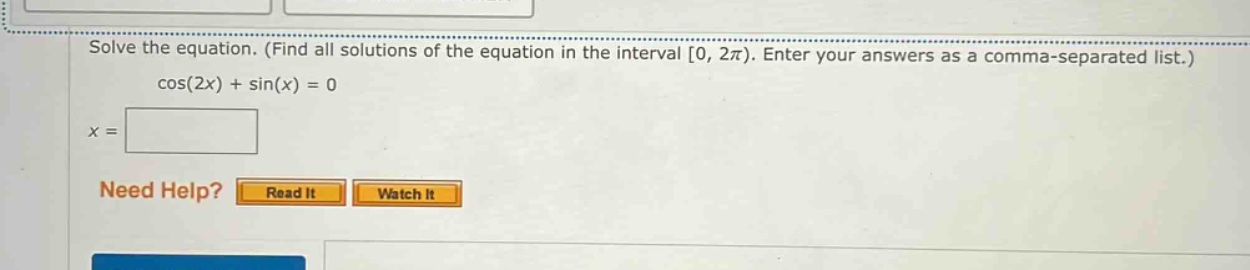
solve the equation. (find all solutions of the equation in the interval $0,2\\pi$). enter your answers as a comma - separated list.)\n$\\cos (2x)+\\sin (x)=0$\n$x=$
Answer
Explanation:
Step1: Use double-angle formula
Use the double - angle formula (\cos(2x)=1 - 2\sin^{2}(x)). The equation (\cos(2x)+\sin(x)=0) becomes (1 - 2\sin^{2}(x)+\sin(x)=0). Let (t = \sin(x)), then the equation is (-2t^{2}+t + 1=0), or (2t^{2}-t - 1=0).
Step2: Solve the quadratic equation
For a quadratic equation (at^{2}+bt + c = 0) ((a = 2), (b=-1), (c = - 1)), the quadratic formula is (t=\frac{-b\pm\sqrt{b^{2}-4ac}}{2a}). [ \begin{align*} t&=\frac{1\pm\sqrt{(-1)^{2}-4\times2\times(-1)}}{2\times2}\ &=\frac{1\pm\sqrt{1 + 8}}{4}\ &=\frac{1\pm3}{4} \end{align*} ] We get (t_1=\frac{1 + 3}{4}=1) and (t_2=\frac{1-3}{4}=-\frac{1}{2}).
Step3: Substitute back and solve for (x)
Since (t=\sin(x)), when (\sin(x)=1), (x=\frac{\pi}{2}) (because (x\in[0,2\pi)) and (\sin(x) = 1) when (x=\frac{\pi}{2}+2k\pi,k\in\mathbb{Z}), in the interval ([0,2\pi)), (k = 0)). When (\sin(x)=-\frac{1}{2}), (x=\frac{7\pi}{6}) or (x=\frac{11\pi}{6}) (because (\sin(x)=-\frac{1}{2}) when (x=\frac{7\pi}{6}+2k\pi) or (x=\frac{11\pi}{6}+2k\pi,k\in\mathbb{Z}), in the interval ([0,2\pi)), (k = 0)).
Answer:
(\frac{\pi}{2},\frac{7\pi}{6},\frac{11\pi}{6})