solve for the exact solutions in the interval 0,2π). if the e\n1/2tan²(x)=1 - sec(x)\nquestion help: message…
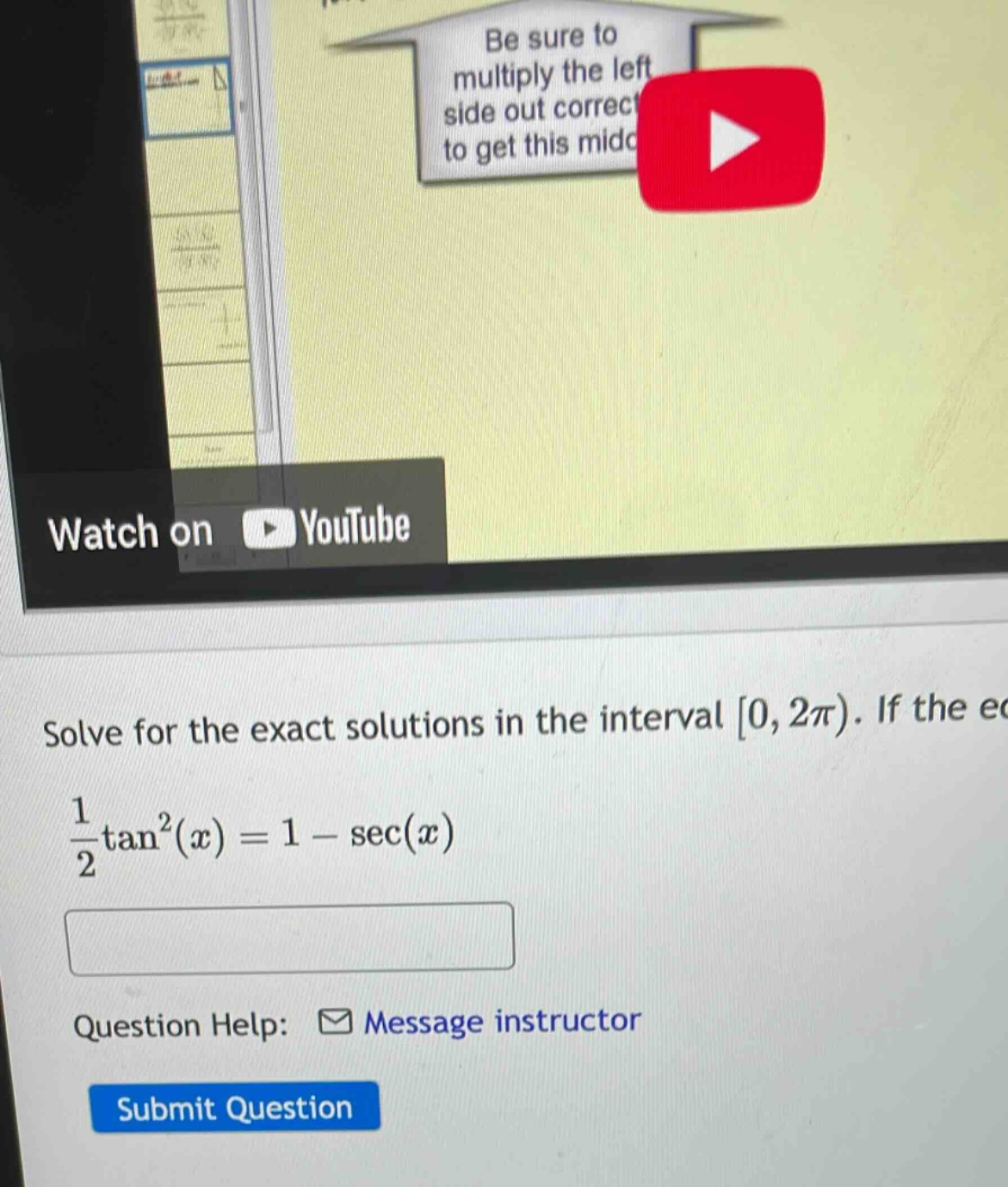
solve for the exact solutions in the interval 0,2π). if the e\n1/2tan²(x)=1 - sec(x)\nquestion help: message instructor\nsubmit question
Answer
Explanation:
Step1: Use trig - identity
Recall that $\tan^{2}(x)=\sec^{2}(x)-1$. Substitute this into the given equation: $\frac{1}{2}(\sec^{2}(x)-1)=1 - \sec(x)$.
Step2: Expand the left - hand side
$\frac{1}{2}\sec^{2}(x)-\frac{1}{2}=1 - \sec(x)$.
Step3: Rearrange to form a quadratic equation
Let $u = \sec(x)$. Then the equation becomes $\frac{1}{2}u^{2}+\ u-\frac{3}{2}=0$. Multiply through by 2 to get $u^{2}+2u - 3=0$.
Step4: Factor the quadratic equation
Factor $u^{2}+2u - 3$ as $(u + 3)(u - 1)=0$.
Step5: Solve for $u$
Setting each factor equal to zero gives $u+3 = 0$ or $u - 1=0$. So $u=-3$ or $u = 1$.
Step6: Substitute back $\sec(x)$ for $u$
If $\sec(x)=-3$, then $\cos(x)=-\frac{1}{3}$. Using the inverse - cosine function, $x=\cos^{-1}(-\frac{1}{3})+2k\pi$ or $x = 2\pi-\cos^{-1}(-\frac{1}{3})+2k\pi$. In the interval $[0,2\pi)$, $x=\pi\pm\cos^{-1}(\frac{1}{3})$. If $\sec(x)=1$, then $\cos(x)=1$, and $x = 0$.
Answer:
$x = 0,\pi+\cos^{-1}(\frac{1}{3}),\pi-\cos^{-1}(\frac{1}{3})$