a spinning top can be represented by a sine function. the top completes 12 whole rotations in a time period…
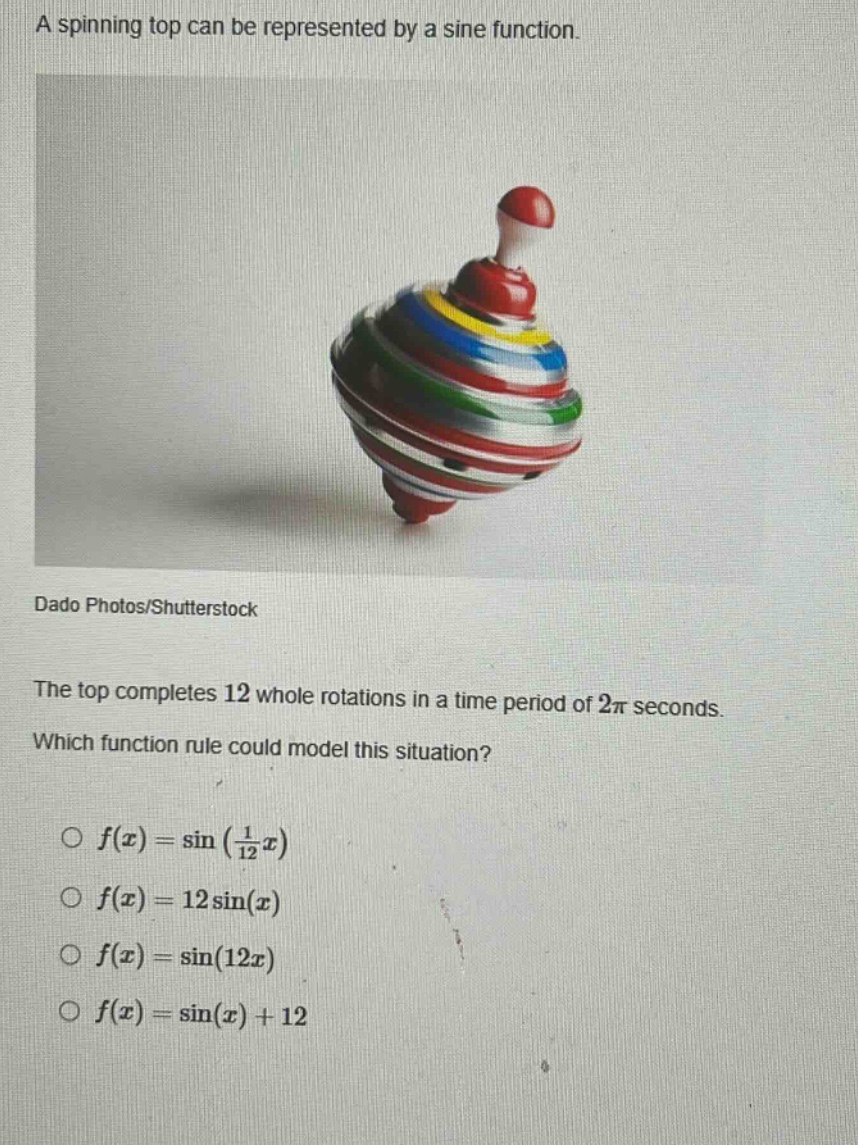
a spinning top can be represented by a sine function. the top completes 12 whole rotations in a time period of 2π seconds. which function rule could model this situation? o f(x)=sin(1/12x) o f(x)=12sin(x) o f(x)=sin(12x) o f(x)=sin(x)+12
Answer
Explanation:
Step1: Recall the general form of a sine - function
The general form of a sine - function is $y = A\sin(Bx - C)+D$, where the period $T=\frac{2\pi}{B}$.
Step2: Determine the period of the spinning top
The top completes 12 rotations in $2\pi$ seconds. The period of one rotation is the time for one full cycle. If 12 rotations occur in $2\pi$ seconds, then the period $T$ of one rotation is $\frac{2\pi}{12}=\frac{\pi}{6}$ seconds.
Step3: Find the value of B
We know that $T = \frac{2\pi}{B}$. Substituting $T=\frac{\pi}{6}$ into the formula, we get $\frac{\pi}{6}=\frac{2\pi}{B}$. Cross - multiplying gives $\pi B = 12\pi$, so $B = 12$.
Step4: Identify the function
Since $A = 1$, $C = 0$, and $D = 0$ (no vertical stretch, phase shift, or vertical shift mentioned), the function is $f(x)=\sin(12x)$.
Answer:
$f(x)=\sin(12x)$