the spread of a highly contagious virus in a high school can be described by the logistic function y = 4800…
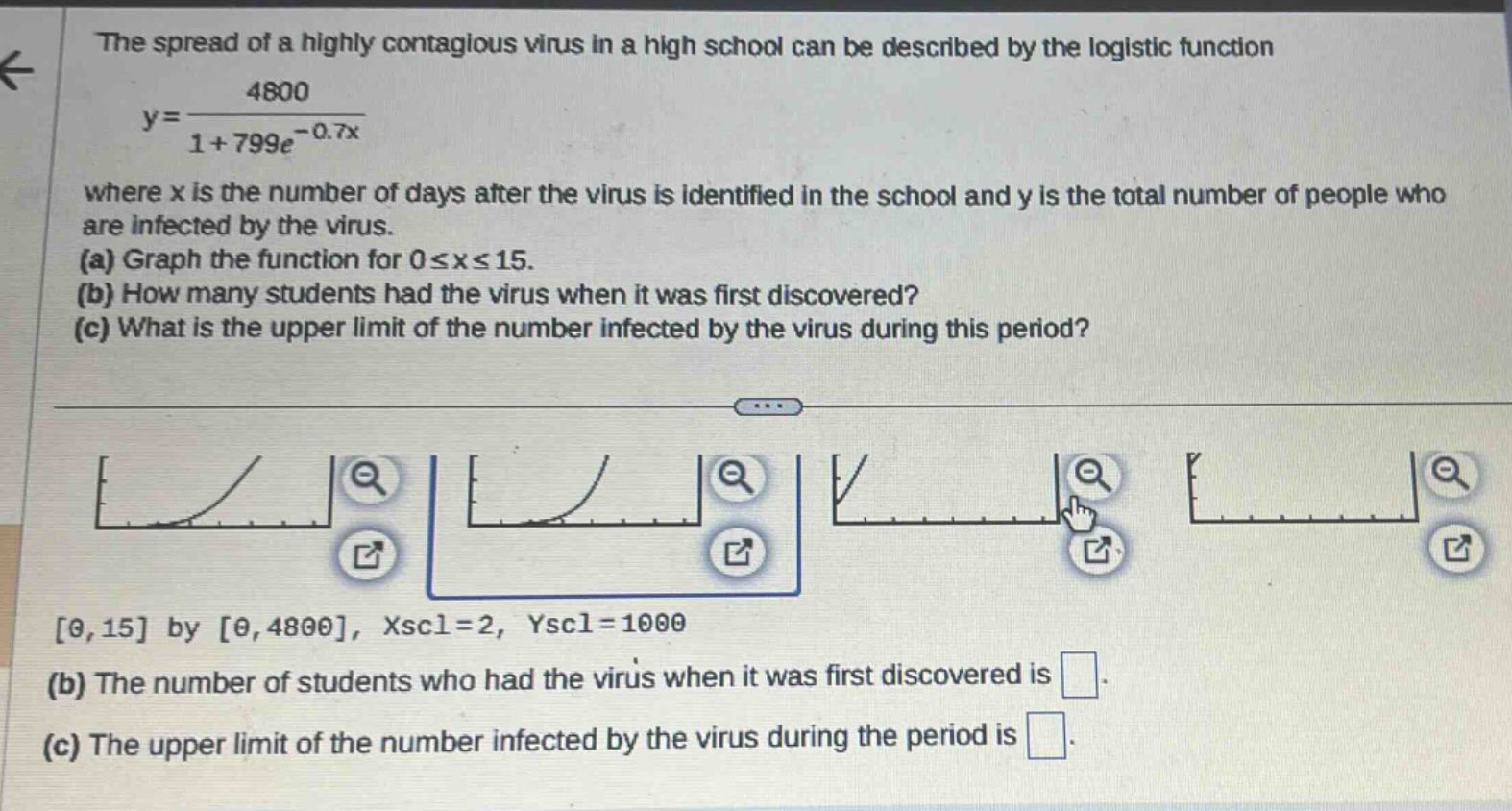
the spread of a highly contagious virus in a high school can be described by the logistic function y = 4800 / (1 + 799e^(-0.7x)) where x is the number of days after the virus is identified in the school and y is the total number of people who are infected by the virus. (a) graph the function for 0 ≤ x ≤ 15. (b) how many students had the virus when it was first discovered? (c) what is the upper limit of the number infected by the virus during this period? 0, 15 by 0, 4800, xscl = 2, yscl = 1000 (b) the number of students who had the virus when it was first discovered is . (c) the upper limit of the number infected by the virus during the period is
Answer
Answer:
(b) 6 (c) 4800
Explanation:
Step1: Find initial - infected number
When the virus was first discovered, (x = 0). Substitute (x = 0) into (y=\frac{4800}{1 + 799e^{-0.7x}}). Since (e^{-0.7\times0}=e^{0}=1), then (y=\frac{4800}{1 + 799\times1}=\frac{4800}{800}=6).
Step2: Find upper - limit
As (x\to+\infty), (e^{-0.7x}=\frac{1}{e^{0.7x}}\to0). Then (y=\lim_{x\to+\infty}\frac{4800}{1 + 799e^{-0.7x}}=\frac{4800}{1+0}=4800). So the upper - limit of the number of infected people is 4800.