a. squares with sides of length x are cut out of each corner of a rectangular piece of cardboard measuring…
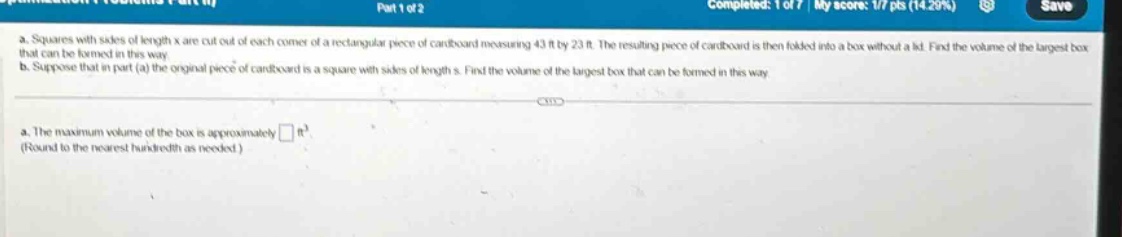
a. squares with sides of length x are cut out of each corner of a rectangular piece of cardboard measuring 43 ft by 23 ft. the resulting piece of cardboard is then folded into a box without a lid. find the volume of the largest box that can be formed in this way. b. suppose that in part (a) the original piece of cardboard is a square with sides of length s. find the volume of the largest box that can be formed in this way. a. the maximum volume of the box is approximately □ ft³ (round to the nearest hundredth as needed.)
Answer
Explanation:
Step1: Find the volume function
The length of the box after cutting out squares of side - length $x$ from a rectangular cardboard of dimensions $43$ ft by $23$ ft and folding it into a box without a lid is $L = 43 - 2x$, the width is $W=23 - 2x$, and the height is $H = x$. The volume function $V(x)$ is given by $V(x)=(43 - 2x)(23 - 2x)x$. [ \begin{align*} V(x)&=(43\times23-43\times2x-2x\times23 + 4x^{2})x\ &=(989-86x - 46x+4x^{2})x\ &=(989x-132x^{2}+4x^{3}) \end{align*} ]
Step2: Find the derivative of the volume function
Differentiate $V(x)=4x^{3}-132x^{2}+989x$ with respect to $x$. Using the power - rule $\frac{d}{dx}(ax^{n})=nax^{n - 1}$, we get $V^\prime(x)=12x^{2}-264x + 989$.
Step3: Find the critical points
Set $V^\prime(x)=0$, so $12x^{2}-264x + 989 = 0$. Using the quadratic formula $x=\frac{-b\pm\sqrt{b^{2}-4ac}}{2a}$ for the quadratic equation $ax^{2}+bx + c = 0$, here $a = 12$, $b=-264$, and $c = 989$. [ \begin{align*} x&=\frac{264\pm\sqrt{(-264)^{2}-4\times12\times989}}{2\times12}\ &=\frac{264\pm\sqrt{69696-47472}}{24}\ &=\frac{264\pm\sqrt{22224}}{24}\ &=\frac{264\pm149.08}{24} \end{align*} ] We get $x_1=\frac{264 + 149.08}{24}\approx17.96$ and $x_2=\frac{264-149.08}{24}\approx4.79$. But $x$ must satisfy $0\lt x\lt\frac{23}{2}=11.5$ (because if $x\geq11.5$, then $23 - 2x\leq0$). So we consider $x\approx4.79$.
Step4: Find the maximum volume
Substitute $x\approx4.79$ into the volume function $V(x)=(43 - 2x)(23 - 2x)x$. [ \begin{align*} V(4.79)&=(43-2\times4.79)(23 - 2\times4.79)\times4.79\ &=(43 - 9.58)(23-9.58)\times4.79\ &=(33.42)(13.42)\times4.79\ &=33.42\times64.3818\ &\approx2152.63 \end{align*} ]
Answer:
$2152.63$