3.) on a standard summer day in upstate new york, the temperature outside can be modeled using the…
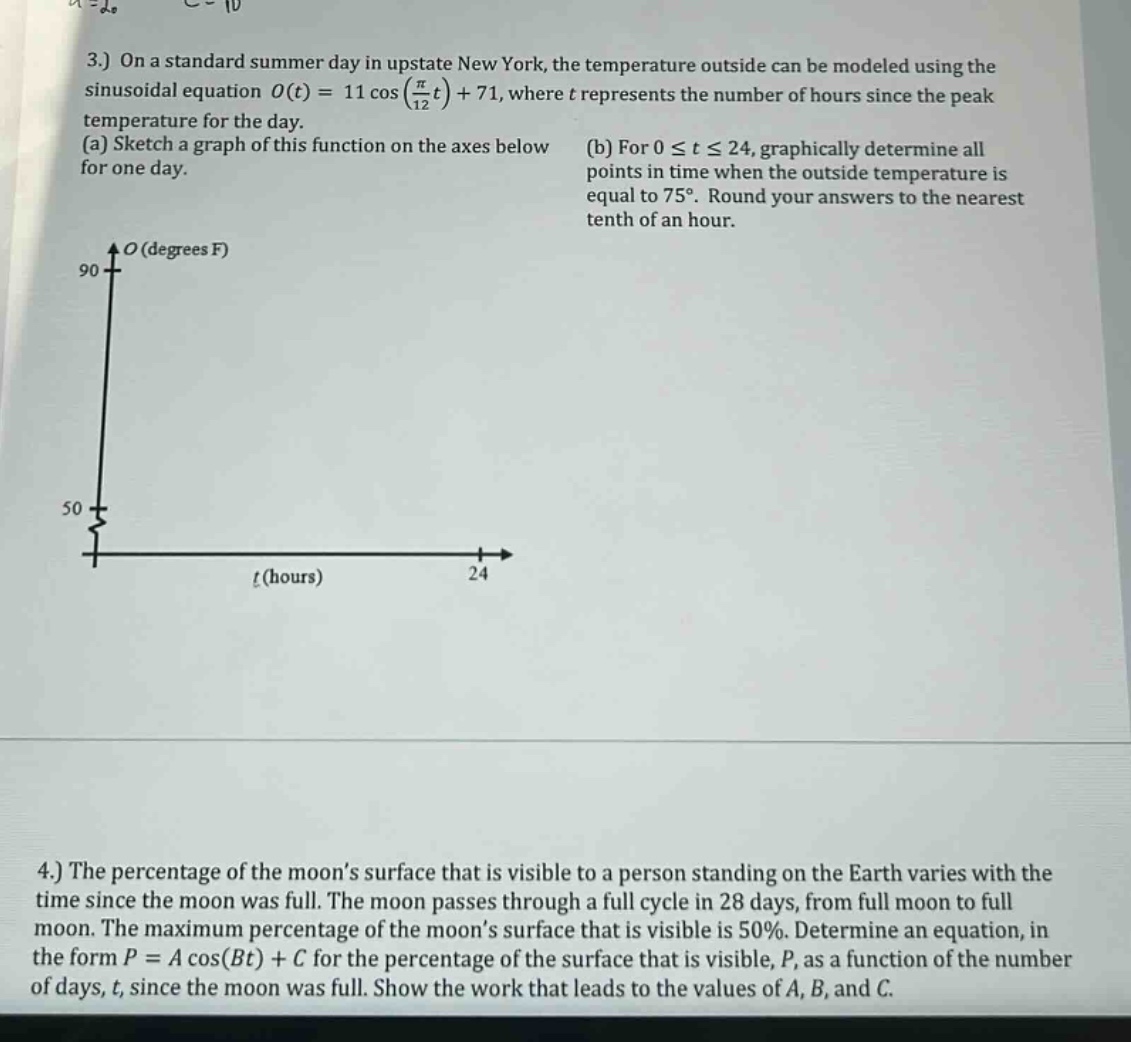
3.) on a standard summer day in upstate new york, the temperature outside can be modeled using the sinusoidal equation o(t)=11 cos(π/12 t)+71, where t represents the number of hours since the peak temperature for the day. (a) sketch a graph of this function on the axes below for one day. (b) for 0 ≤ t ≤ 24, graphically determine all points in time when the outside temperature is equal to 75°. round your answers to the nearest tenth of an hour. 4.) the percentage of the moons surface that is visible to a person standing on the earth varies with the time since the moon was full. the moon passes through a full cycle in 28 days, from full moon to full moon. the maximum percentage of the moons surface that is visible is 50%. determine an equation, in the form p = a cos(bt)+c for the percentage of the surface that is visible, p, as a function of the number of days, t, since the moon was full. show the work that leads to the values of a, b, and c.
Answer
Explanation:
Step1: Analyze the general form of sinusoidal - function
The general form of a sinusoidal function is $y = A\cos(Bx)+C$. For the temperature function $O(t)=11\cos(\frac{\pi}{12}t)+71$, $A = 11$, $B=\frac{\pi}{12}$, and $C = 71$.
Step2: Sketch the graph for part (a)
- The amplitude $|A| = 11$, the vertical - shift $C = 71$, and the period $T=\frac{2\pi}{B}$. Since $B=\frac{\pi}{12}$, $T=\frac{2\pi}{\frac{\pi}{12}}=24$ hours. The maximum value of $O(t)$ is $71 + 11=82$ and the minimum value is $71-11 = 60$. When $t = 0$, $O(0)=11\cos(0)+71=11\times1 + 71=82$.
Step3: Solve for part (b)
Set $O(t)=75$. Then $11\cos(\frac{\pi}{12}t)+71 = 75$. Subtract 71 from both sides: $11\cos(\frac{\pi}{12}t)=75 - 71=4$. So, $\cos(\frac{\pi}{12}t)=\frac{4}{11}\approx0.3636$. Then $\frac{\pi}{12}t=\pm\cos^{-1}(0.3636)+2k\pi$, $k\in\mathbb{Z}$. For $0\leq t\leq24$, when $\frac{\pi}{12}t=\cos^{-1}(0.3636)$: $t=\frac{12}{\pi}\cos^{-1}(0.3636)\approx\frac{12}{\pi}\times1.2094\approx4.6$. When $\frac{\pi}{12}t = 2\pi-\cos^{-1}(0.3636)$: $t=\frac{12}{\pi}(2\pi-\cos^{-1}(0.3636))=\frac{12}{\pi}(2\pi - 1.2094)\approx24 - 4.6=19.4$.
Step4: Solve for part (4)
- The period $T = 28$ days. Since $T=\frac{2\pi}{B}$, then $28=\frac{2\pi}{B}$, and $B=\frac{2\pi}{28}=\frac{\pi}{14}$.
- The maximum value of $P$ is $50%$ and the minimum value is $0%$. The amplitude $A=\frac{50 - 0}{2}=25$.
- The vertical - shift $C=\frac{50 + 0}{2}=25$. So the equation is $P = 25\cos(\frac{\pi}{14}t)+25$.
Answer:
(a) Sketch a cosine - type graph with amplitude 11, vertical shift 71, and period 24 hours, starting at the maximum value of 82 at $t = 0$. (b) $t\approx4.6$ hours and $t\approx19.4$ hours. (4) $P = 25\cos(\frac{\pi}{14}t)+25$