starting with the graph of y = e^x, use transformations to sketch the graph of the function and state its…
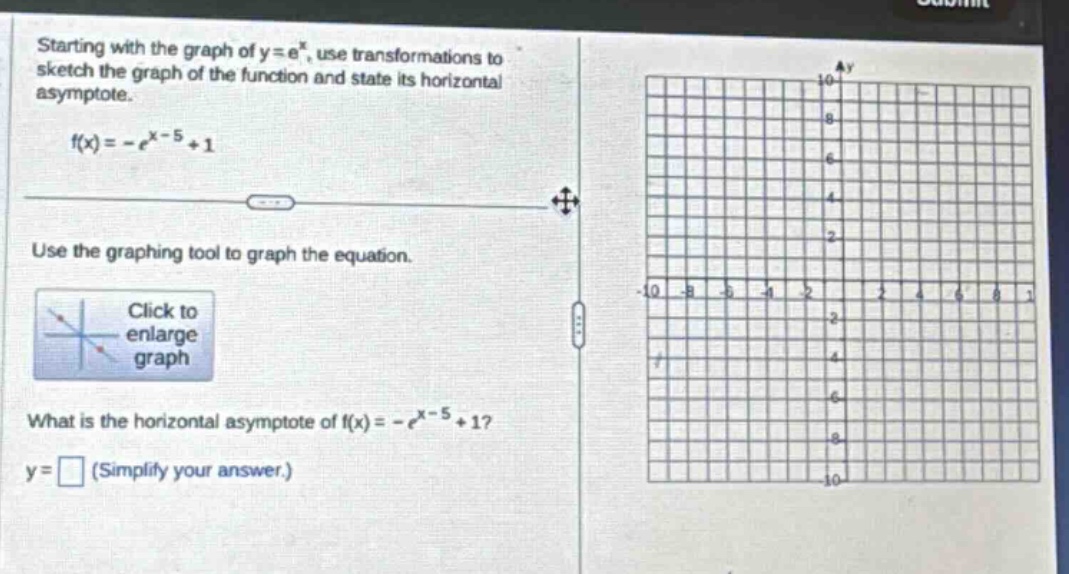
starting with the graph of y = e^x, use transformations to sketch the graph of the function and state its horizontal asymptote. f(x)=-e^(x - 5)+1 use the graphing tool to graph the equation. click to enlarge graph what is the horizontal asymptote of f(x)=-e^(x - 5)+1? y = □ (simplify your answer.)
Answer
Explanation:
Step1: Recall properties of exponential - function
The parent function is $y = e^{x}$, which has a horizontal asymptote at $y = 0$.
Step2: Analyze the transformation of $y=-e^{x - 5}+1$
For the function $y=-e^{x - 5}+1$, the negative sign in front of $e^{x-5}$ reflects the graph of $y = e^{x}$ about the $x$ - axis. The $x-5$ inside the exponent shifts the graph 5 units to the right, and the $+ 1$ shifts the graph 1 unit up.
Step3: Determine the horizontal asymptote
When we start with the horizontal asymptote $y = 0$ of $y = e^{x}$, after reflecting about the $x$ - axis, the asymptote remains $y = 0$. After shifting 1 unit up, the horizontal asymptote of $y=-e^{x - 5}+1$ is $y = 1$.
Answer:
$y = 1$