4. state where the graph of the function f(x)=-∛(x + 1)-2 is increasing and decreasing. increasing: never…
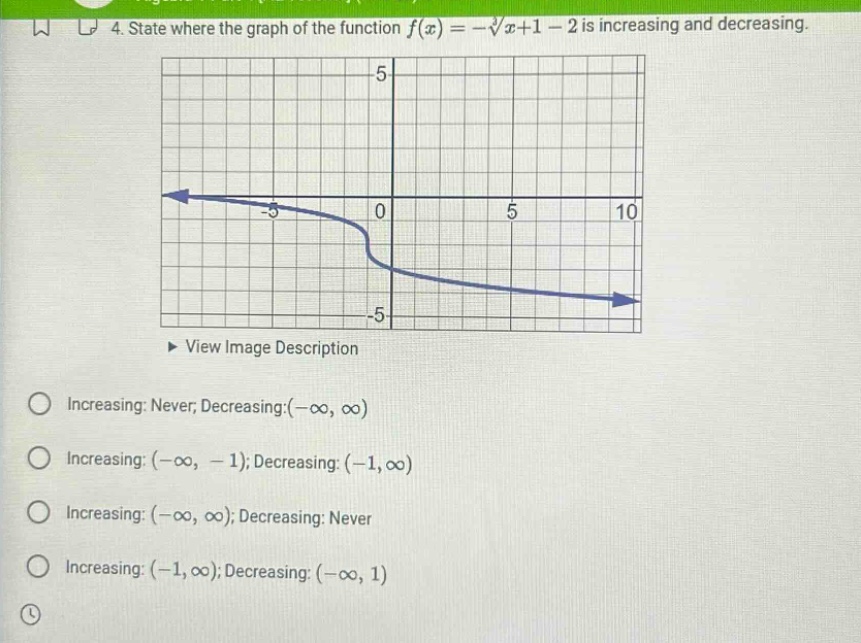
4. state where the graph of the function f(x)=-∛(x + 1)-2 is increasing and decreasing. increasing: never; decreasing:(-∞, ∞) increasing: (-∞, -1); decreasing: (-1,∞) increasing: (-∞, ∞); decreasing: never increasing: (-1,∞); decreasing: (-∞, 1)
Answer
Explanation:
Step1: Recall derivative - increasing - decreasing relationship
The function $y = f(x)$ is increasing when $f'(x)>0$ and decreasing when $f'(x)<0$. First, find the derivative of $f(x)=-\sqrt[3]{x + 1}-2=-(x + 1)^{\frac{1}{3}}-2$. Using the power - rule for differentiation $\frac{d}{dx}(u^n)=nu^{n - 1}u'$, where $u=x + 1$ and $n=\frac{1}{3}$. $f'(x)=-\frac{1}{3}(x + 1)^{-\frac{2}{3}}\times1=-\frac{1}{3(x + 1)^{\frac{2}{3}}}$.
Step2: Analyze the sign of the derivative
The denominator $3(x + 1)^{\frac{2}{3}}>0$ for all $x\neq - 1$. The numerator is $-1$. So, $f'(x)=-\frac{1}{3(x + 1)^{\frac{2}{3}}}<0$ for all $x\neq - 1$. The function is defined for all real numbers $x\in(-\infty,\infty)$. Since the derivative is negative for all $x$ in the domain of the function, the function is decreasing on $(-\infty,\infty)$ and never increasing.
Answer:
Increasing: Never; Decreasing:$(-\infty,\infty)$