state the open intervals over which the function is (a) increasing, (b) decreasing, and (c) constant. your…
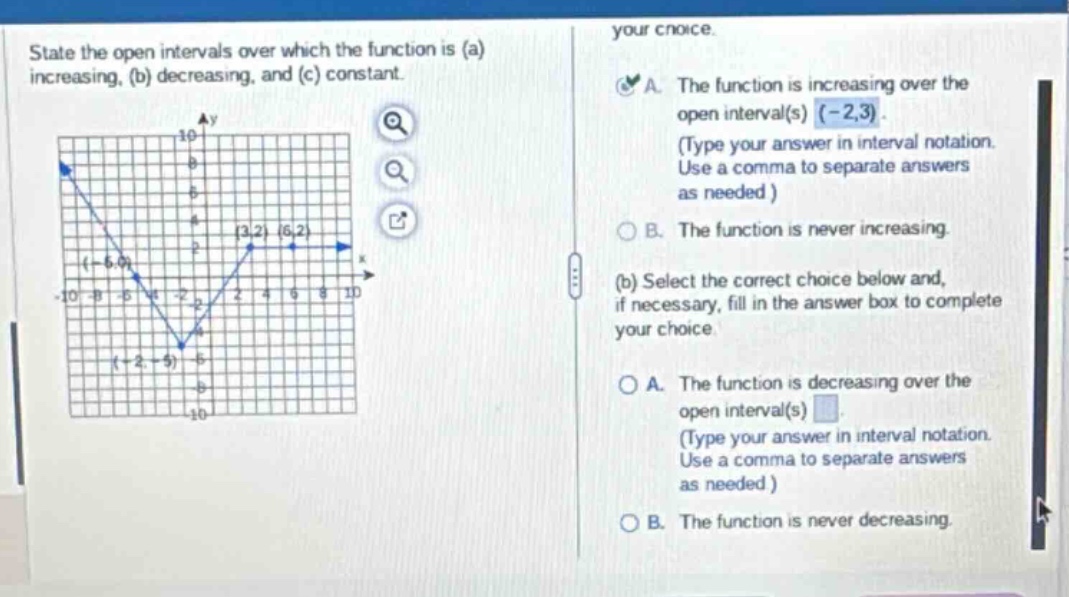
state the open intervals over which the function is (a) increasing, (b) decreasing, and (c) constant. your choice. a. the function is increasing over the open interval(s) (-2,3). (type your answer in interval notation. use a comma to separate answers as needed ) b. the function is never increasing. (b) select the correct choice below and, if necessary, fill in the answer box to complete your choice. a. the function is decreasing over the open interval(s) (type your answer in interval notation. use a comma to separate answers as needed ) b. the function is never decreasing.
Answer
Explanation:
Step1: Recall increasing - decreasing rules
A function is increasing when the y - values increase as the x - values increase, decreasing when y - values decrease as x - values increase.
Step2: Analyze the graph for decreasing intervals
Looking at the graph, the function is decreasing from (x=-6) to (x = - 2). In interval notation, this is ((-6,-2)).
Answer:
(a) A. The function is increasing over the open interval(s) ((-2,3)). (b) A. The function is decreasing over the open interval(s) ((-6,-2))