state the range for the function f(x) = -ln(x - 1) + 2 : (-∞, ∞) (-∞, -1) (1, ∞) (-∞, -2)
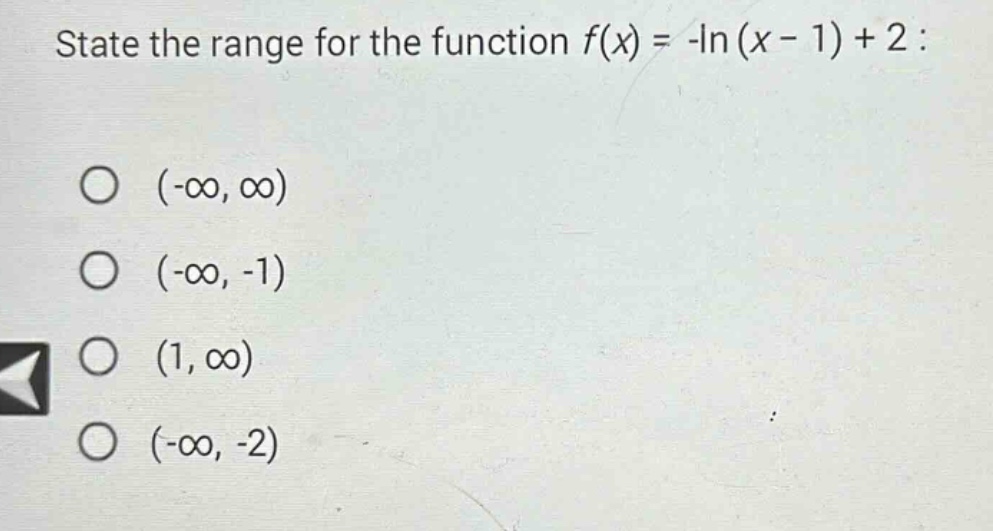
state the range for the function f(x) = -ln(x - 1) + 2 : (-∞, ∞) (-∞, -1) (1, ∞) (-∞, -2)
Answer
Explanation:
Step1: Recall the range of the natural - log function
The range of the natural - log function $y = \ln(u)$ is $(-\infty,\infty)$ for $u>0$. In the function $f(x)=-\ln(x - 1)+2$, let $u=x - 1$ where $x>1$ (since the argument of the logarithm $x - 1>0$).
Step2: Analyze the transformation of the function
The function $y =-\ln(x - 1)+2$ is a transformation of the natural - log function. The negative sign in front of $\ln(x - 1)$ reflects the graph of $y = \ln(x - 1)$ about the $x$-axis, and the $+2$ shifts the graph of $y=-\ln(x - 1)$ upward by 2 units. But the range of $y =-\ln(x - 1)$ is still $(-\infty,\infty)$ (because reflecting $y=\ln(x - 1)$ about the $x$-axis does not change the set of all possible $y$-values), and shifting it upward by 2 units does not change the fact that the set of all possible $y$-values is $(-\infty,\infty)$.
Answer:
$(-\infty,\infty)$