which statement accurately describes how adding a number, n, to the function (f(x)=sin(x)) affects its…
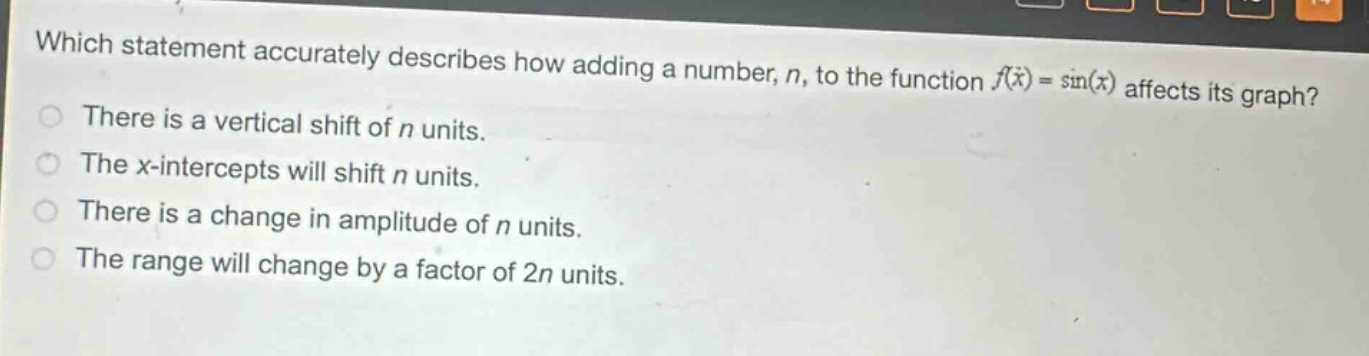
which statement accurately describes how adding a number, n, to the function (f(x)=sin(x)) affects its graph? there is a vertical shift of n units. the x - intercepts will shift n units. there is a change in amplitude of n units. the range will change by a factor of 2n units.
Answer
Brief Explanations:
For a function $y = f(x)+n$, it represents a vertical shift of the graph of $y = f(x)$. When we add $n$ to $f(x)=\sin(x)$ to get $y=\sin(x)+n$, every $y -$ value of the original sine - function is increased by $n$. The $x$-intercepts do not shift by $n$ units, the amplitude of $y = \sin(x)$ is 1 and adding $n$ does not change the amplitude, and the range of $y=\sin(x)$ is $[- 1,1]$, adding $n$ shifts the range to $[-1 + n,1 + n]$ not changing it by a factor of $2n$.
Answer:
There is a vertical shift of $n$ units.