which statement accurately describes how adding a number, n, to the function (f(x)=sin(x)) affects its…
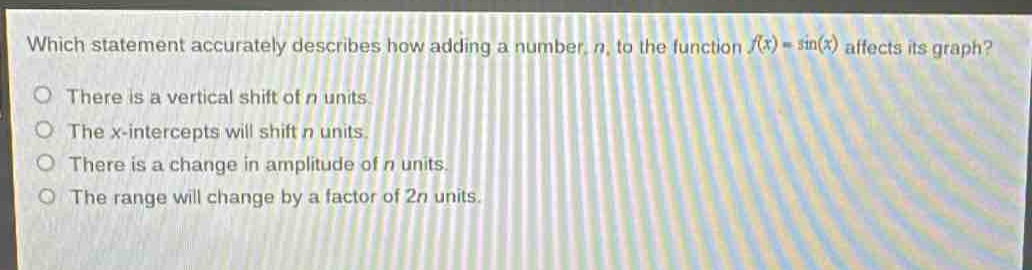
which statement accurately describes how adding a number, n, to the function (f(x)=sin(x)) affects its graph?\nthere is a vertical shift of n units\nthe x - intercepts will shift n units.\nthere is a change in amplitude of n units.\nthe range will change by a factor of 2n units.
Answer
Answer:
There is a vertical shift of n units.
Explanation:
Step1: Recall function - transformation rule
For a function (y = f(x)), the transformation (y=f(x)+n) represents a vertical - shift.
Step2: Analyze the given function
The original function is (y = \sin(x)), and the new function is (y=\sin(x)+n). According to the rule, when we add a constant (n) to the function (y = \sin(x)), the graph of the function (y=\sin(x)) is shifted vertically by (n) units. If (n>0), the shift is upward; if (n < 0), the shift is downward.
Step3: Analyze other options
- The (x) - intercepts do not shift by (n) units. The (x) - intercepts of (y = \sin(x)) are (x = k\pi,k\in\mathbb{Z}), and for (y=\sin(x)+n), the (x) - intercepts are found by solving (\sin(x)+n = 0), or (\sin(x)=-n), which is a different calculation than a simple shift of (n) units.
- The amplitude of (y = \sin(x)) is 1, and adding a constant (n) does not change the amplitude. The amplitude is related to the coefficient of the trigonometric function, and here the coefficient of (\sin(x)) remains 1.
- The range of (y = \sin(x)) is ([- 1,1]). For (y=\sin(x)+n), the range is ([-1 + n,1 + n]), which is a vertical shift of the range, not a change by a factor of (2n) units.