which statement correctly identifies a local minimum of the graphed function? over the interval -3, -2, the…
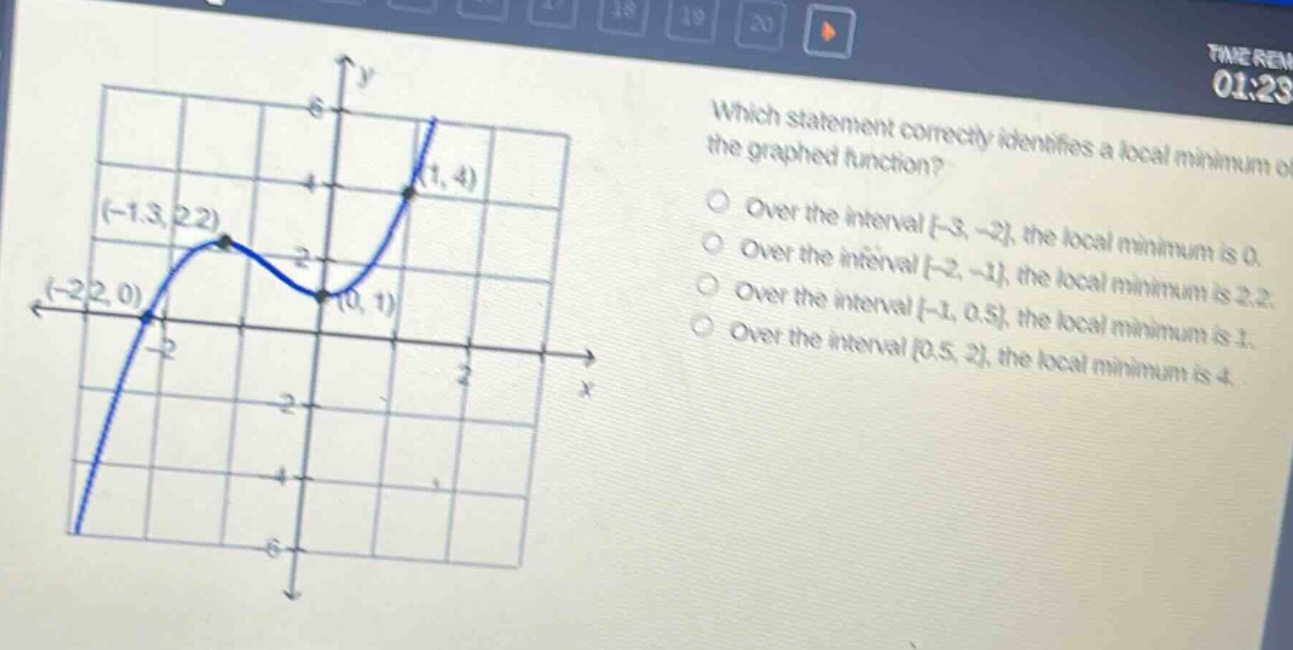
which statement correctly identifies a local minimum of the graphed function? over the interval -3, -2, the local minimum is 0. over the interval -2, -1, the local minimum is 2.2. over the interval -1, 0.5, the local minimum is 1. over the interval 0.5, 2, the local minimum is 4.
Answer
Explanation:
Step1: Understand local - minimum concept
A local minimum is a point where the function value is less than or equal to the values of the function in a small neighborhood around it.
Step2: Check interval [-3, -2]
There is no information about the function outside the given points in this interval, but from the graph, we can't say the local - minimum is 0 as there are no data points indicating that.
Step3: Check interval [-2, -1]
The function value at (x = 0) is 1, and in the interval ([-2,-1]), the function values are higher than 1 in the neighborhood around (x = 0). So, the local - minimum is not 2.2.
Step4: Check interval [-1, 0.5]
The point ((0,1)) is in the interval ([-1,0.5]). The function values around (x = 0) in this interval are higher than 1. So, the local - minimum in the interval ([-1,0.5]) is 1.
Step5: Check interval [0.5, 2]
The local - minimum in ([0.5,2]) is not 4 as the function value at (x = 0) (which is in a related neighborhood) is 1 and lower than 4.
Answer:
Over the interval ([-1,0.5]), the local minimum is 1.