which statement correctly identifies a local minimum of the graphed function?\nover the interval -3, -2, the…
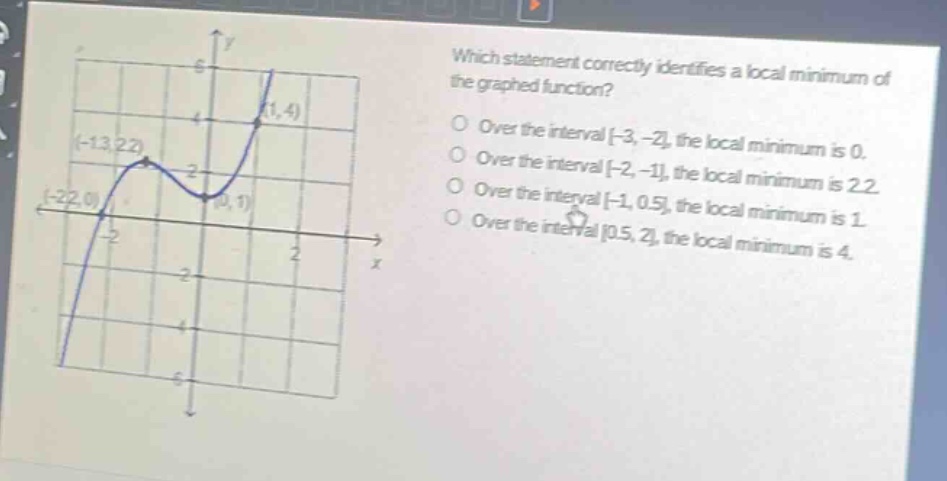
which statement correctly identifies a local minimum of the graphed function?\nover the interval -3, -2, the local minimum is 0.\nover the interval -2, -1, the local minimum is 2.2.\nover the interval -1, 0.5, the local minimum is 1.\nover the interval 0.5, 2, the local minimum is 4.
Answer
Explanation:
Step1: Analyze interval [-3, -2]
Check function values in [-3, -2]. At x = - 2, y = 0. Function is decreasing then increasing in this interval, and 0 is the minimum value.
Step2: Analyze interval [-2, -1]
In [-2, -1], the function value at x=-1.3 is 2.2. But the function value at x = - 2 is 0 which is less than 2.2, so 2.2 is not the minimum.
Step3: Analyze interval [-1, 0.5]
In [-1, 0.5], at x = 0, y = 1. But the function value at x=-1.3 (in the extended - view of the domain around this interval) is 2.2 and also we need to consider the behavior in the whole interval. The function value at x = 0 is the minimum in this interval.
Step4: Analyze interval [0.5, 2]
In [0.5, 2], at x = 1, y = 4. But the function value at x = 0 (in the extended - view of the domain around this interval) is 1 which is less than 4, so 4 is not the minimum.
Answer:
Over the interval [-3, -2], the local minimum is 0.