which statement is false?\narctan(-1)=\frac{3pi}{4}\ntan^{-1}(-sqrt{3})=-\frac{pi}{3}\ncos^{-1}(0)=\frac{pi}{…
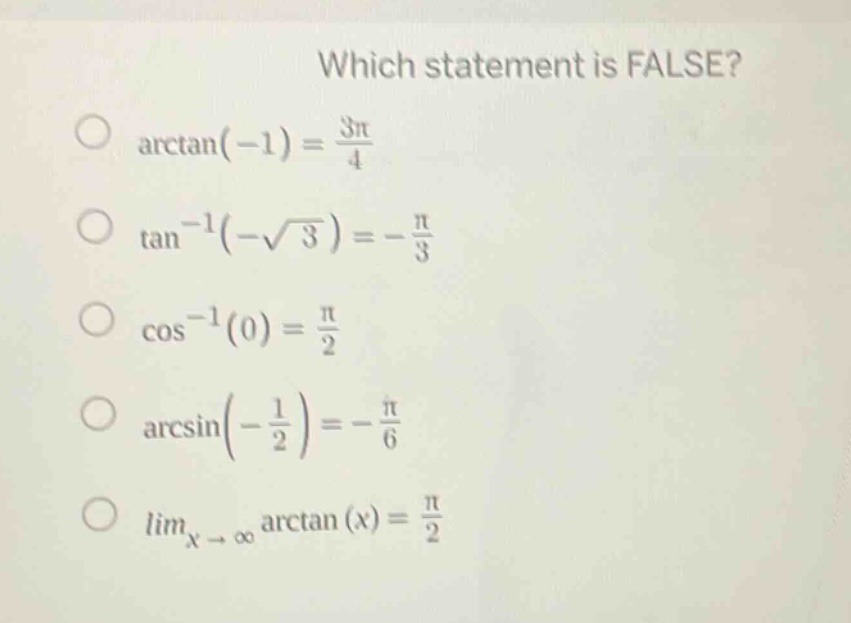
which statement is false?\narctan(-1)=\frac{3pi}{4}\ntan^{-1}(-sqrt{3})=-\frac{pi}{3}\ncos^{-1}(0)=\frac{pi}{2}\narcsin(-\frac{1}{2})=-\frac{pi}{6}\nlim_{x\rightarrowinfty}arctan(x)=\frac{pi}{2}
Answer
Explanation:
Step1: Recall the range of inverse - tangent function
The range of (y = \arctan(x)) is ((-\frac{\pi}{2},\frac{\pi}{2})). Since (\arctan(-1)) should be in ((-\frac{\pi}{2},\frac{\pi}{2})), and (\tan(-\frac{\pi}{4})=- 1), so (\arctan(-1)=-\frac{\pi}{4}\neq\frac{3\pi}{4}).
Step2: Check (\tan^{-1}(-\sqrt{3}))
The range of (y = \tan^{-1}(x)) is ((-\frac{\pi}{2},\frac{\pi}{2})), and (\tan(-\frac{\pi}{3})=-\sqrt{3}), so (\tan^{-1}(-\sqrt{3})=-\frac{\pi}{3}).
Step3: Check (\cos^{-1}(0))
The range of (y=\cos^{-1}(x)) is ([0,\pi]), and (\cos(\frac{\pi}{2}) = 0), so (\cos^{-1}(0)=\frac{\pi}{2}).
Step4: Check (\arcsin(-\frac{1}{2}))
The range of (y = \arcsin(x)) is ([-\frac{\pi}{2},\frac{\pi}{2}]), and (\sin(-\frac{\pi}{6})=-\frac{1}{2}), so (\arcsin(-\frac{1}{2})=-\frac{\pi}{6}).
Step5: Check (\lim_{x\rightarrow\infty}\arctan(x))
As (x\rightarrow\infty), the value of (y = \arctan(x)) approaches (\frac{\pi}{2}) since the range of (y=\arctan(x)) is ((-\frac{\pi}{2},\frac{\pi}{2})) and the function is increasing.
Answer:
A. (\arctan(-1)=\frac{3\pi}{4})