which statement about the graph of y = tan x is true?\na. the period is 2π.\nb. the function has horizontal…
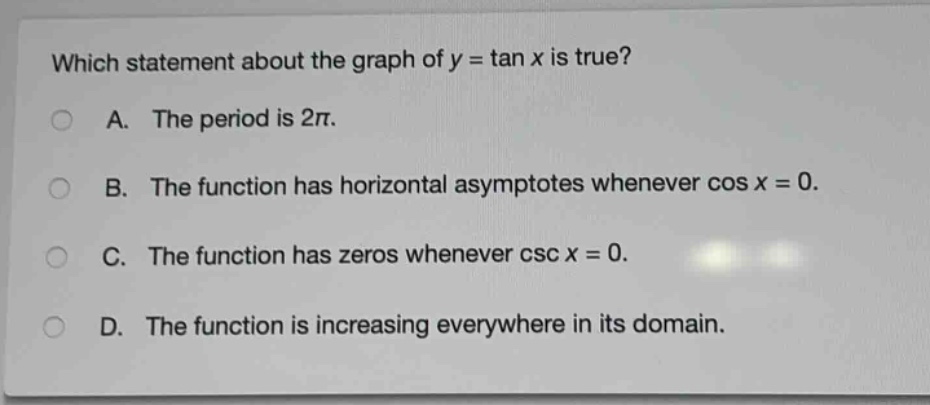
which statement about the graph of y = tan x is true?\na. the period is 2π.\nb. the function has horizontal asymptotes whenever cos x = 0.\nc. the function has zeros whenever csc x = 0.\nd. the function is increasing everywhere in its domain.
Answer
Explanation:
Step1: Recall period of tangent function
The period of $y = \tan x$ is $\pi$, not $2\pi$, so A is false.
Step2: Analyze asymptotes of tangent function
Since $\tan x=\frac{\sin x}{\cos x}$, when $\cos x = 0$, the function is undefined and has vertical asymptotes, not horizontal asymptotes, so B is false.
Step3: Analyze zeros of tangent function
$\csc x=\frac{1}{\sin x}$, and $\csc x$ is never equal to 0. Also, $\tan x = 0$ when $\sin x=0$ and $\cos x\neq0$. So C is false.
Step4: Analyze the monotonicity of tangent function
The derivative of $y = \tan x$ is $y'=\sec^{2}x>0$ for all $x$ in the domain of $\tan x$ (where $\cos x\neq0$). So the function $y = \tan x$ is increasing everywhere in its domain.
Answer:
D. The function is increasing everywhere in its domain.