which statement is true about the asymptotes of a rational function if the degree of the polynomial function…
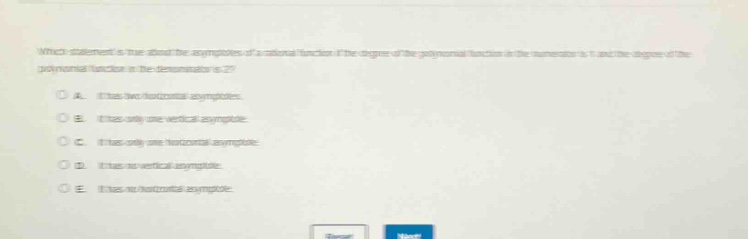
which statement is true about the asymptotes of a rational function if the degree of the polynomial function in the numerator is 1 and the degree of the polynomial function in the denominator is 2?\na. it has two horizontal asymptotes.\nb. it has only one vertical asymptote.\nc. it has only one horizontal asymptote.\nd. it has no vertical asymptote.\ne. it has no horizontal asymptote.
Answer
Explanation:
Step1: Recall asymptote rules for rational functions
If the degree of the polynomial function in the numerator ($n$) is 1 and the degree of the polynomial function in the denominator ($m$) is 2, then $n<m$.
Step2: Determine the type of asymptotes
When $n < m$ for a rational function $\frac{f(x)}{g(x)}$, the horizontal - asymptote is $y = 0$ (the $x$ - axis), and the vertical asymptotes are found by setting the denominator $g(x)=0$. Since the denominator is non - zero for some values and zero for others, there are vertical asymptotes.
Answer:
C. It has only one horizontal asymptote.