which statement is true about the discontinuities of the function f(x)?\n f(x)=\frac{x^{2}-4}{x^{3}-x^{2}-2x}…
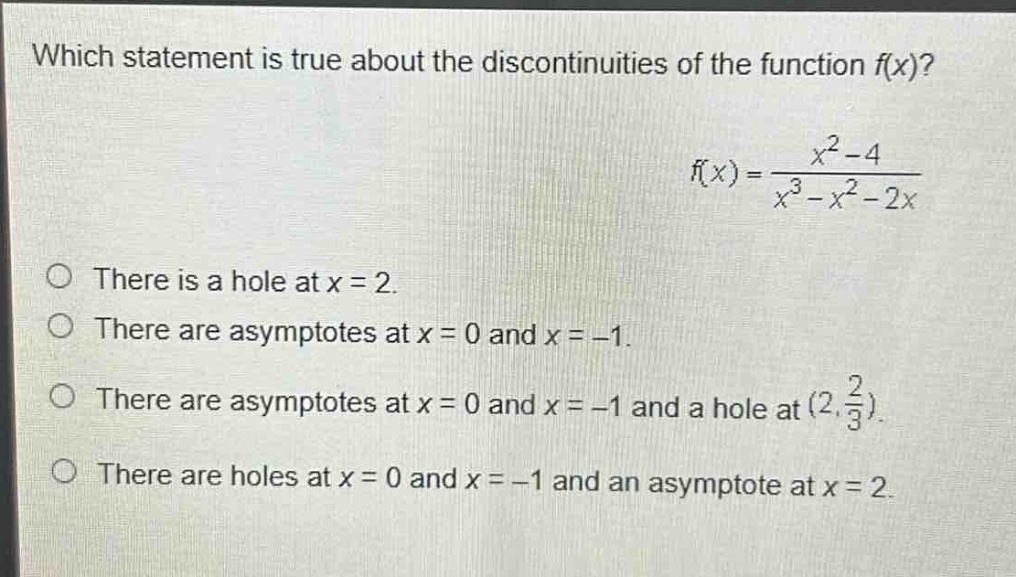
which statement is true about the discontinuities of the function f(x)?\n f(x)=\frac{x^{2}-4}{x^{3}-x^{2}-2x} \nthere is a hole at x = 2.\nthere are asymptotes at x = 0 and x = -1.\nthere are asymptotes at x = 0 and x = -1 and a hole at ( (2,\frac{2}{3}) ).\nthere are holes at x = 0 and x = -1 and an asymptote at x = 2.
Answer
Explanation:
Step1: Factor the numerator and denominator
The numerator $x^{2}-4=(x + 2)(x - 2)$. The denominator $x^{3}-x^{2}-2x=x(x^{2}-x - 2)=x(x - 2)(x+1)$. So $f(x)=\frac{(x + 2)(x - 2)}{x(x - 2)(x + 1)}$.
Step2: Find the holes
A hole occurs when a factor can be canceled out in the numerator and denominator. Canceling out the $(x - 2)$ factor (for $x\neq2$), we get $f(x)=\frac{x + 2}{x(x + 1)}$ for $x\neq2$. When $x = 2$, $f(x)=\frac{2+2}{2\times(2 + 1)}=\frac{4}{6}=\frac{2}{3}$, so there is a hole at $(2,\frac{2}{3})$.
Step3: Find the vertical - asymptotes
Vertical asymptotes occur at the values of $x$ that make the denominator of the simplified function equal to zero. Setting $x(x + 1)=0$, we get $x=0$ and $x=-1$.
Answer:
There are asymptotes at $x = 0$ and $x=-1$ and a hole at $(2,\frac{2}{3})$.