which statement is true about the discontinuities of the function f(x)?\nf(x)=\frac{x + 1}{6x^{2}-7x…
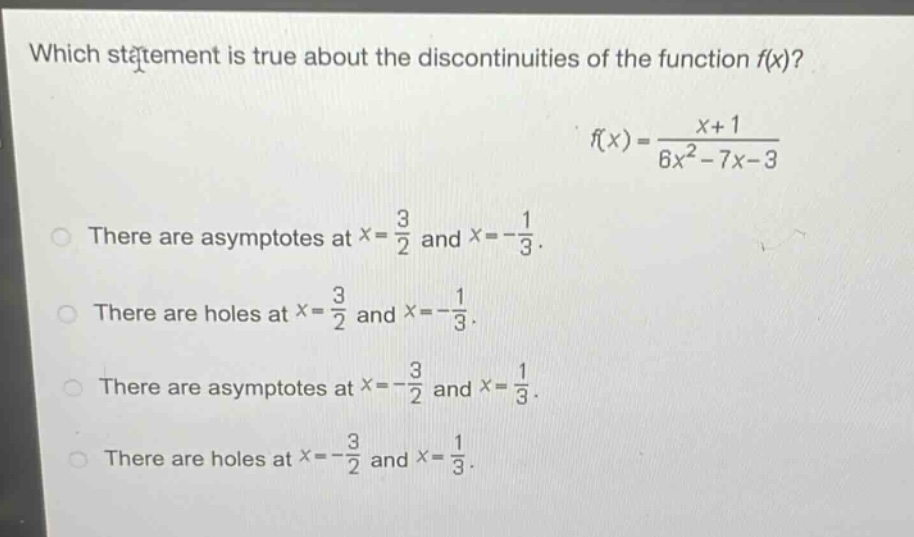
which statement is true about the discontinuities of the function f(x)?\nf(x)=\frac{x + 1}{6x^{2}-7x - 3}\nthere are asymptotes at (x=\frac{3}{2}) and (x =-\frac{1}{3}).\nthere are holes at (x=\frac{3}{2}) and (x =-\frac{1}{3}).\nthere are asymptotes at (x=-\frac{3}{2}) and (x=\frac{1}{3}).\nthere are holes at (x=-\frac{3}{2}) and (x=\frac{1}{3}).
Answer
Explanation:
Step1: Factor the denominator
Factor $6x^{2}-7x - 3$. We have $6x^{2}-7x - 3=6x^{2}-9x + 2x-3=3x(2x - 3)+1(2x - 3)=(2x - 3)(3x+1)$. So $f(x)=\frac{x + 1}{(2x - 3)(3x + 1)}$.
Step2: Find the vertical - asymptotes
Vertical asymptotes occur where the denominator is zero and the numerator is non - zero. Set the denominator equal to zero: $(2x - 3)(3x + 1)=0$. Solving $2x-3 = 0$ gives $x=\frac{3}{2}$, and solving $3x + 1=0$ gives $x=-\frac{1}{3}$. Since the numerator $x + 1$ is non - zero at $x=\frac{3}{2}$ and $x=-\frac{1}{3}$ (when $x=\frac{3}{2}$, $x + 1=\frac{3}{2}+1=\frac{5}{2}\neq0$; when $x=-\frac{1}{3}$, $x + 1=-\frac{1}{3}+1=\frac{2}{3}\neq0$), there are vertical asymptotes at $x=\frac{3}{2}$ and $x=-\frac{1}{3}$.
Answer:
There are asymptotes at $x=\frac{3}{2}$ and $x =-\frac{1}{3}$.